About Arum palaestinum Boiss.
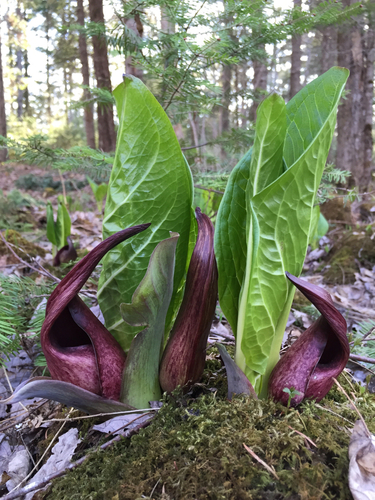
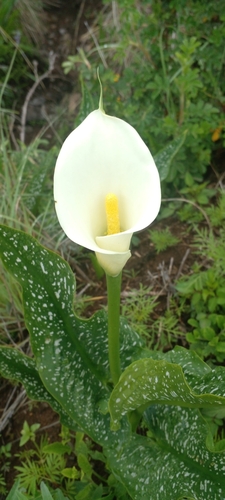
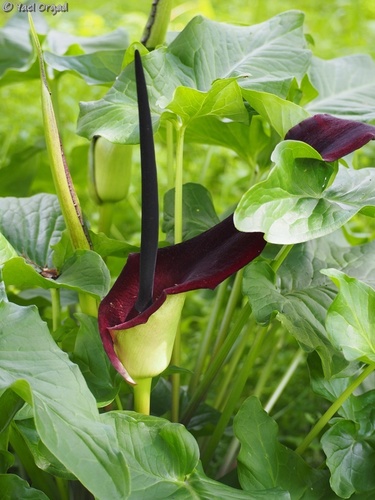
Arum palaestinum Boiss. is a perennial plant that reaches a height of 10–25 cm (4–10 in). Its leaves are light green, narrow, upright, and have a purplish-black color, and it grows from a tuberous root. It blooms between March and April, and is easily identifiable by its dark purplish-black spadix, which is enclosed by a reddish-brown spathe.
Arum species are split into two groups based on relative inflorescence height: "cryptic" species, which bear inflorescences on short peduncles among or below the leaves, and "flag" species, which bear inflorescences above leaf level at the end of long peduncles. A. palaestinum is classified as a cryptic species. Like other Arum species, it produces a scent that attracts flies to distribute its pollen. While most other members of the genus have a scent similar to dung or carrion, this species can also smell like rotting fruit.
This species is native to the Levant and other areas of the Mediterranean Basin, and has become naturalized in Europe, Western Asia, North Africa, North America, and Australia. Early botanical collections of this species were made by Kotschy in 1855 from Jerusalem, Haussknecht in 1867 from Onsuar Gudrun, Barbey in 1880 from Nablus, Johannet in 1889 from Bethany, and Bornmüller in 1897 from Jaffa.
A. palaestinum is toxic even at low doses. This toxicity has traditionally been attributed to oxalate salts, though this has not been confirmed. The plant's leaves contain calcium oxalate and other toxins, which can be removed by leaching. Exposure to the raw plant causes irritation and burning of the mucous membranes; consuming larger doses leads to nausea, diarrhea, and cramping. Skin exposure can also cause irritation, so the plant is usually handled carefully, often with gloves.
After leaching, the leaves and tubers of A. palaestinum are edible; cooking is thought to remove any remaining toxicity. In Middle Eastern cuisine, the leaves are chopped and cooked thoroughly with lemon or sorrel, and are also added to soups. It is commonly eaten with flat bread or bulgur, and its flavor is reported to be similar to Swiss chard.
In traditional Palestinian medicine, extracts of A. palaestinum are used to treat cancer, intestinal worms, open wound infections, urinary tract obstructions, and kidney stones, and are believed to strengthen bones. Iraqi Jews have traditionally used the plant to treat worms, skin sores, syphilis, rheumatism, tuberculosis, and diarrhea; it has also been used to treat cough and constipation. Ethnobotanical data records this as one of the most commonly used plants in the West Bank, reported as used by over half of all survey respondents. In a recent revision of his book Killing Cancer – Not People, author Robert G. Wright discusses the use of this species in a product sold by a dietary supplement company.