About Arum orientale subsp. orientale
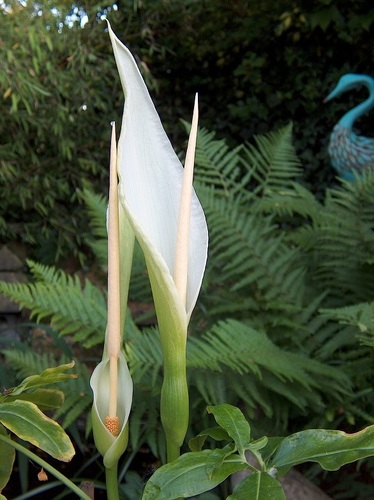
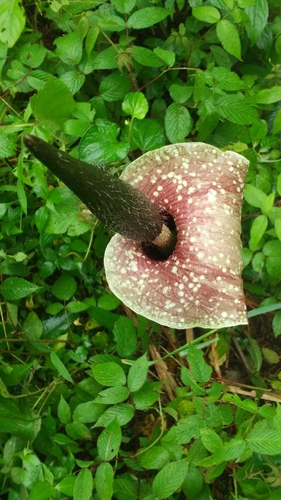
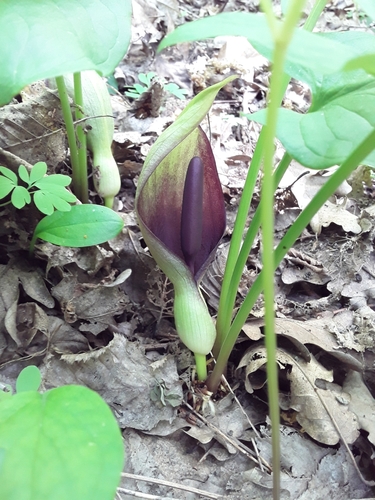
Arum orientale subsp. orientale produces plain green leaves in autumn. In late spring, flowers develop on a poker-shaped inflorescence called a spadix, which is partially enclosed by a pale green, leaf-like hood known as a spathe, which is often marked with purple spotting. The inside of the spathe may be greenish, or dull purple to brownish in color. Flowers are hidden from view, clustered at the base of the spadix: a ring of female flowers sits at the bottom, and a ring of male flowers grows above them. Above the male flowers is a ring of hairs that forms an insect trap. Insects are drawn to the spadix by its foul odor and a temperature that is warmer than the surrounding air. Trapped beneath the ring of hairs, insects become dusted with pollen from the male flowers before they escape. They then carry this pollen to the spadices of other plants, where it pollinates the female flowers. The spadix itself is mid-to pale purple. In late spring and early summer, the lower ring of female flowers develops into a cluster of bright red berries. These berries remain visible after the spathe and other leaves have withered. The attractive red to orange berries are extremely poisonous. They contain saponin oxalates, which have needle-shaped crystals that irritate the skin, mouth, tongue, and throat. Consumption causes throat swelling, difficulty breathing, burning pain, and upset stomach. Because the berries have an acrid taste, and eating them causes an almost immediate tingling sensation in the mouth, people rarely consume large amounts, so serious harm is unusual. Where Arum orientale and Arum maculatum both occur, the two are easily confused. Arum orientale has a much more limited distribution than Arum maculatum. The two species can be distinguished by several traits: the tuber of Arum maculatum is horizontal, while the tuber of Arum orientale is discoid. The interior coloring of the spathe is another distinct characteristic of Arum orientale. This subspecies grows in deciduous woodland or on the edges of coniferous woodland across its range, and prefers partial shade and moderately moist conditions.