About Arum maculatum L.
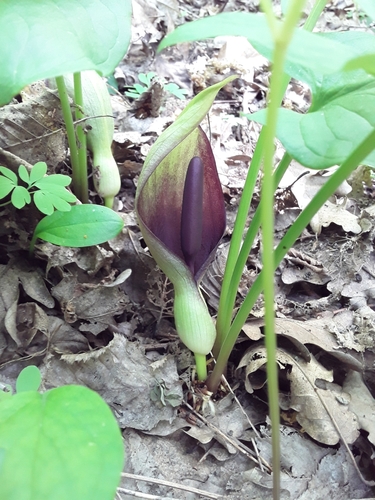
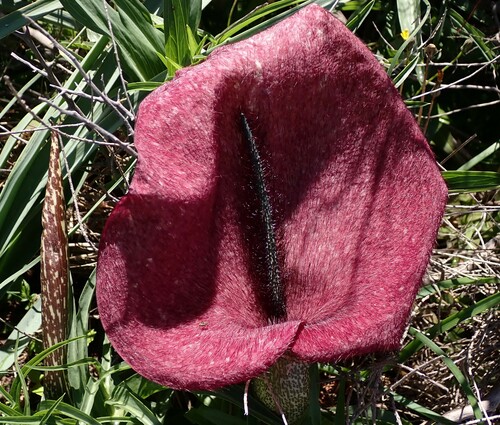
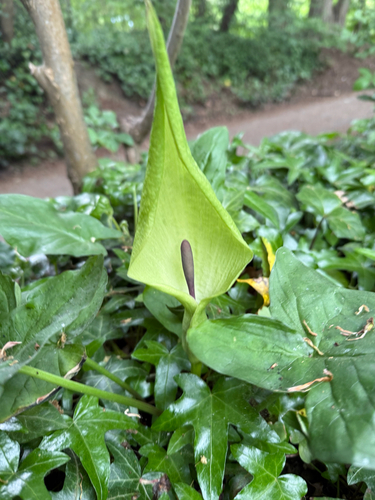
Arum maculatum L. produces leaves in spring—April to May in the northern hemisphere, and October to November in the southern hemisphere. Each leaf grows 7 to 20 cm long, has a triangular shape with a distinct arrowhead-shaped base, and grows on a long stalk. Unlike most monocots, it has net-like rather than linear veins. Its dark green leaves may have purple patches; the purple-spotted form is classified as var. maculatum, while the unspotted form is var. immaculatum. After leaves emerge, flowers develop on a poker-shaped inflorescence called a spadix, which is partially enclosed by a pale green, leaf-like hood called a spathe. Arum species are split into two groups based on inflorescence position: cryptic species, which have short peduncles that hold inflorescences at or below leaf level, and flag species, which have long peduncles that hold inflorescences above leaf level. A. maculatum is a cryptic species. The spathe can reach up to 25 cm in height, and the later-developing fruiting spike can grow up to 5 cm tall. Flowers are hidden from view, clustered at the base of the spadix, with a ring of female flowers at the bottom and a ring of male flowers positioned above them. Above the male flowers sits a ring of hairs that acts as an insect trap. Purple is the most common color for the spadix, though it may also be yellow. Insects, particularly the owl-midge Psychoda phalaenoides, are drawn to the spadix by its faecal odor and a temperature that can be up to 15 °C warmer than the surrounding air. Trapped insects below the hair ring get coated in pollen from the male flowers before they escape, then carry this pollen to the spadices of other A. maculatum plants to pollinate the female flowers. In autumn, the fertilized female flowers develop into a cluster of bright red berries that can reach 5 cm long; these berries remain visible after the spathe and other leaves have withered. These bright red to orange berries are extremely poisonous. The plant stores starch in a large root-tuber, which can grow as deep as 400 mm below ground in mature specimens. It is common to find A. maculatum individuals with much of their spadix eaten away, as many small rodents find the spadix particularly attractive. As flowers mature, the spadix produces heat and likely scent, which attracts these rodents. In the British Isles, A. maculatum is commonly called cuckoo pint or cuckoo-pint, and it is listed under this name in Nicholas Culpeper's famous 17th-century herbal. It shares this common name with Arum italicum (Italian lords-and-ladies), the other native British Arum species. The word "pint" is a shortening of "pintle", a term for penis, chosen for the shape of the spadix; this euphemistic shortening can be traced back to Turner in 1551. A. maculatum is propagated when birds eat its berries and disperse the seeds. Seedlings start with small, light green leaves that lack the glossy texture of mature leaves. After about 5 months, the leaves grow larger and become glossier. By one year of age, all leaves are fully glossy, then die back. The plant will flower in summer the following year. This species grows in woodland areas and along riversides, and can occasionally grow as a weed in partially shaded locations. All parts of A. maculatum can cause allergic reactions in many people, so the plant should be handled with care. The attractive berries are extremely poisonous to many animals, including humans, but they are harmless to birds, which eat them and spread the plant's seeds. The berries contain oxalates of saponins, which have needle-shaped crystals that irritate the skin, mouth, tongue, and throat. Consumption causes throat swelling, difficulty breathing, burning pain, and upset stomach. However, the berries have an acrid taste and cause an almost immediate tingling sensation in the mouth when eaten, so large amounts are rarely consumed and serious harm is uncommon. A. maculatum is one of the most common causes of accidental plant poisoning that leads to emergency department visits. There is no known antidote for A. maculatum poisoning. Airway management can reduce mortality risk, and aggressive fluid administration may help prevent renal injury.