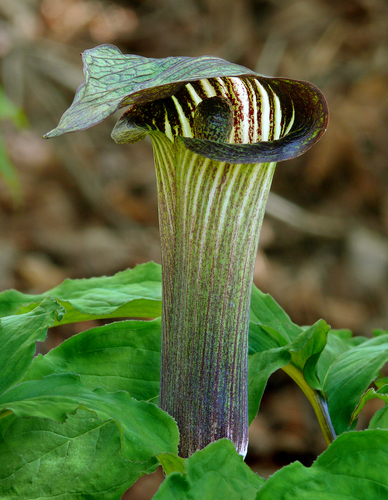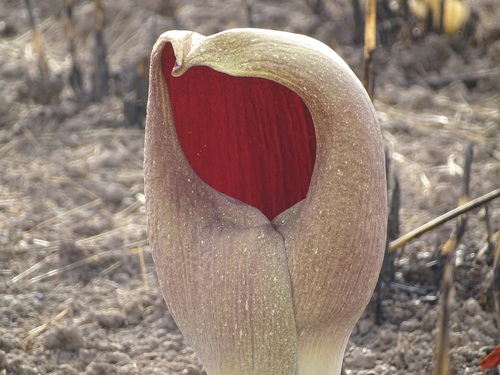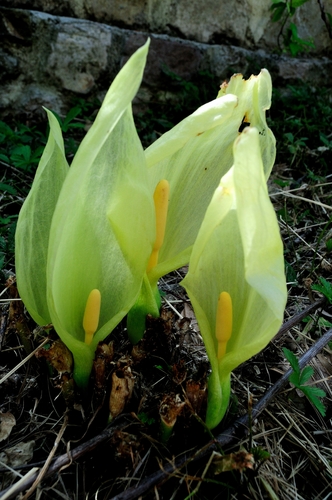
About Arum italicum Mill.
Size
Arum italicum Mill. reaches a height and spread of 30–46 cm (1–1.5 ft).
Flowering and Fruit
It blooms in spring, producing white flowers that develop into conspicuous red fruit.
Inflorescence Species Groups
Arum species are categorized into two groups based on relative inflorescence height: 'cryptic' species, which bear inflorescences on short peduncles that sit among or below the leaves, and 'flag' species, which bear inflorescences above leaf level at the end of long peduncles. A. italicum is classified as a cryptic species.
Inflorescence Heat Observation
In 1778, Lamarck observed that the inflorescence of this plant produces heat.
Chromosome Count
A. italicum typically has a chromosome count of 2n = 84, though a small number of subspecies, such as subsp. albispathum, have 2n = 56.
Distribution Overview
The native distribution of Arum italicum varies by subspecies.
Subsp. italicum Native Range
A. italicum subsp. italicum is native to Albania, Algeria, the Balearic Islands, Bulgaria, Corsica, Cyprus, France, Greece, Iraq, Italy, Crete, Crimea, Morocco, Portugal, Sardinia, Sicily, Spain, Switzerland, Tunisia, Turkey, Turkish Thrace, and Yugoslavia.
Subsp. albispathum Native Range
A. italicum subsp. albispathum is native to Crimea, North Caucasus, Transcaucasus, and Turkey.
Subsp. canariense Native Range
A. italicum subsp. canariense is native to the Azores, Canary Islands, and Madeira.
Subsp. neglectum Native Range
A. italicum subsp. neglectum is native to Algeria, France, Great Britain, Morocco, and Spain.
Introduced Range
Subspecies italicum has been introduced across multiple continents, with established populations in northeast Argentina, Austria, Belgium, Germany, Great Britain, Ireland, the Netherlands, northern New Zealand, and the U.S. states of Illinois, Maryland, Missouri, New York, and North Carolina.
Toxic Compounds
All parts of Arum italicum—including leaves, fruits, and rhizomes—contain poisonous compounds, and the plant is particularly rich in oxalates.
Ingestion Risks
Ingesting the tuber can be fatal, as it damages the kidneys, digestive tract, and brain.
Skin Irritation Risk
The plant’s sap can also cause skin irritation, so gloves are recommended when handling or removing the plant.
Famine Use
In Croatia, the corms of Arum italicum were eaten during periods of famine.
Ornamental Use
Arum italicum is grown as an ornamental plant for traditional and woodland shade gardens.
Subspecies Cultivation Differences
The most commonly cultivated subspecies, subsp. italicum, has distinctive pale leaf veins, while subsp. neglectum, commonly called late cuckoo pint, has faint pale leaf veins, and its leaves may also have dark spots.
Subspecies Distinctiveness
Intermediate forms between these two subspecies are known to occur, and the distinctiveness of the two subspecies has been called into question.
Garden Companion Planting
Many gardeners use this arum as an underplanting for Hosta, because the two species produce foliage sequentially: when Hosta foliage withers, A. italicum produces new foliage in early winter, maintaining consistent ground cover.
Cultivars
Numerous cultivars have been developed for garden use; A. italicum subsp. italicum 'Marmoratum' has received the Royal Horticultural Society's Award of Garden Merit.