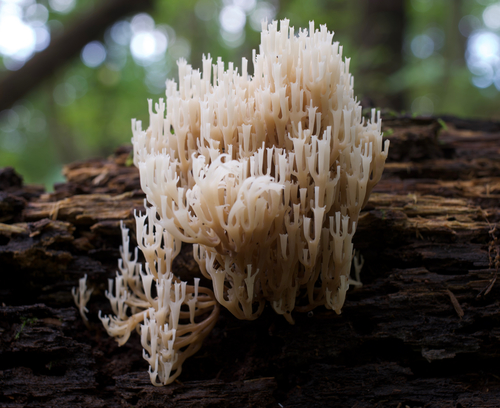
About Artomyces pyxidatus (Pers.) Jülich
Artomyces pyxidatus produces hard, coral-like fruiting bodies that grow 4–10 centimetres (1+1⁄2–4 inches) tall. The colour of these structures ranges from cream to semi-tan. Its branches grow in ring-like arrangements that resemble a crown. Basidia and basidiospores develop on the branch surfaces, and this species produces a white spore print. The sesquiterpene compounds pyxidatols A-C, tsuicoline E, and omphadiol have been extracted from liquid cultures of this fungus. In eastern North America, Artomyces pyxidatus grows on decaying wood from June to September. It can also be found throughout Northern Canada during the growing season. In Britain, the fungus was recorded in 2011, nearly 116 years after the previous reliable report: a collection made by mycologist Carleton Reale on 20 October 1886. Two additional records have been documented in Britain since 2011: one by Yvonne Davidson in Kent in 2018, and another by Cameron Ambler in East Sussex in 2021. Another individual was found in Kent in 2023. The species is widespread but uncommon across Western Europe. It is also widely found in the pine forests of northeastern India, a region referred to as the "eight sisters of India". Although this fungus usually occurs in small, insubstantial quantities, it is considered edible raw, and has improved flavor and texture when cooked. One mushroom guide notes it is best served fried with chopped potatoes. Tribal groups in Northeast India have served this fungus as part of meals since ancient times.