About Artocarpus hirsutus Lam.
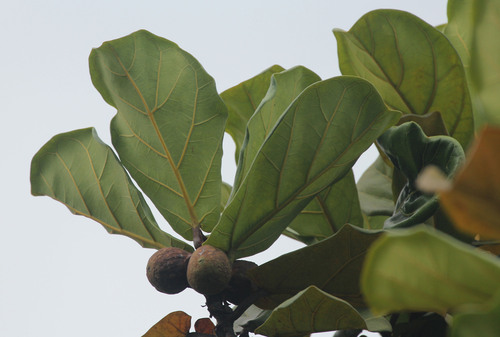
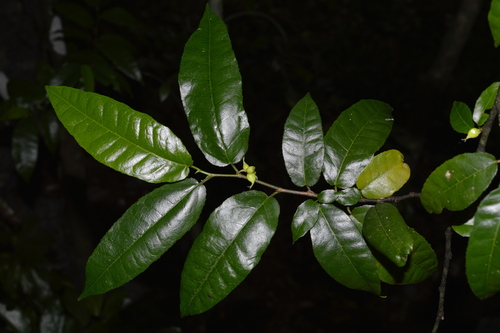
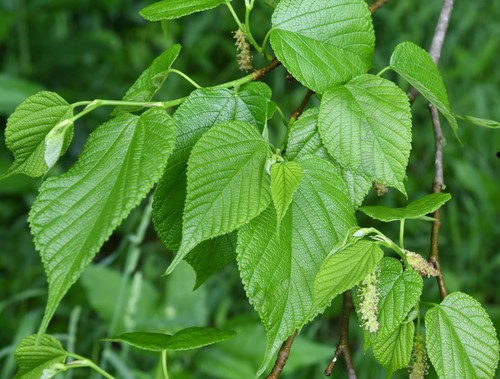
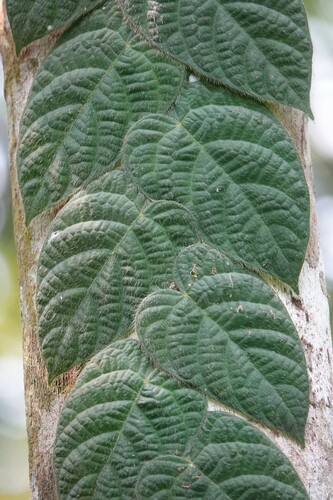
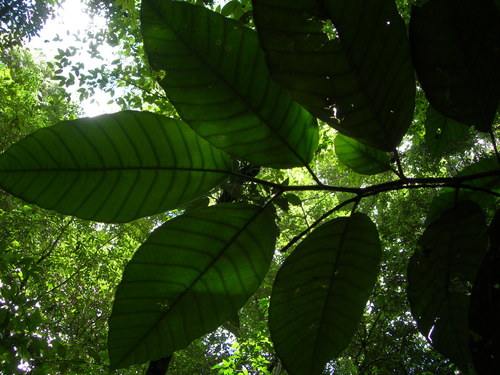
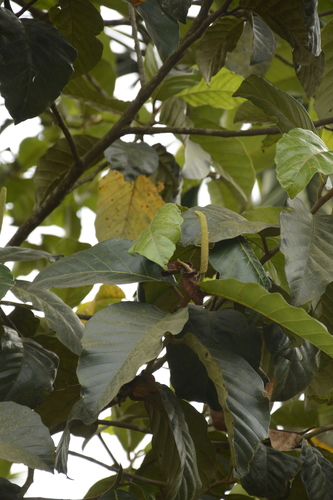
Artocarpus hirsutus Lam. is a canopy tree that can reach up to 35 metres (115 ft) in height and about 4.5 m (15 ft) in girth. It has simple, alternately arranged leaves that are elliptic or ovate in shape, measuring 10–25 cm (4–10 in) long by 5–14 cm (2–6 in) wide. Young leaves are densely hirsute on the underside. Leaf apexes are sub-acute or shortly acuminate, bases are rounded or sub-acute, and margins are undulate. Ten to twelve pairs of secondary leaf nerves are visible, and petioles are 1.5–3 cm (0.6–1.2 in) long. Broken simple, alternate leaves ooze latex. Flowers are unisexual and borne in axillary inflorescences. Fruits are syncarps, very sweet, and turn orange when fully ripe. The fruit structure is similar to that of the much larger jackfruit, with a spiny outer skin that must be removed before eating the ripe fruit. Its seeds are also edible, commonly fried and eaten as a snack. This species grows at elevations from sea level up to around 1,000 m (3,300 ft), in areas that receive 1,500 mm (60 in) or more of annual rainfall. It is endemic to the Western Ghats, found in evergreen forests, and is a common tree in evergreen and semi-evergreen forests ranging from South Maharashtra to Kanyakumari. Artocarpus hirsutus is harvested for its wood, which is valued as durable timber comparable in quality to teak. Historically, its timber was widely used to build ceilings, door frames, and furniture in older buildings, especially in Kerala. Kerala's famous traditional snake boats are often carved from this tree's wood. In 1980-1981, 140 tons of Artocarpus hirsutus wood from Kerala was used to construct Tim Severin's ship Sohar, which Severin sailed from Muscat to Canton.