About Artocarpus altilis (Parkinson) Fosberg
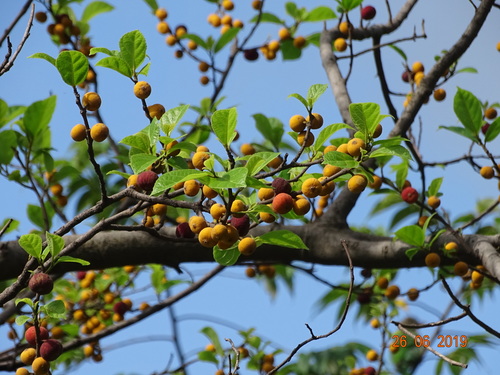
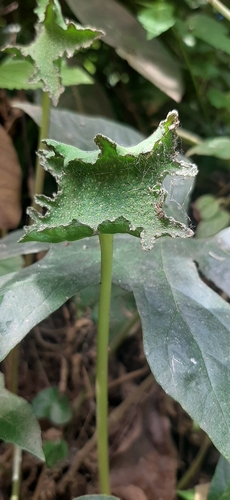
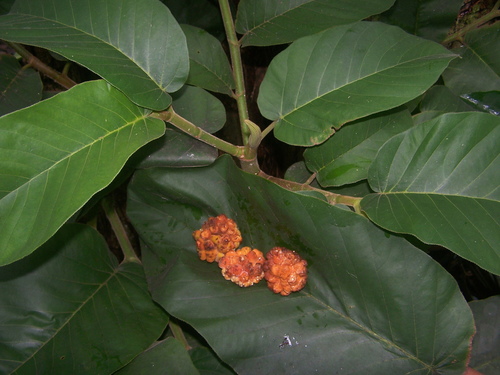
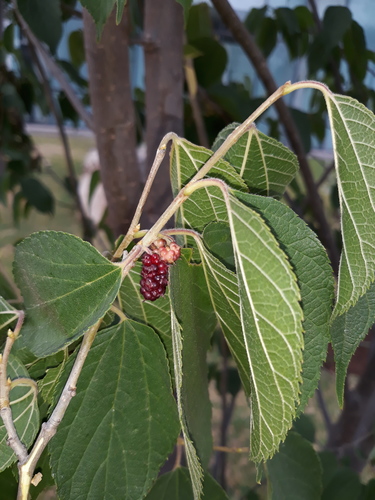
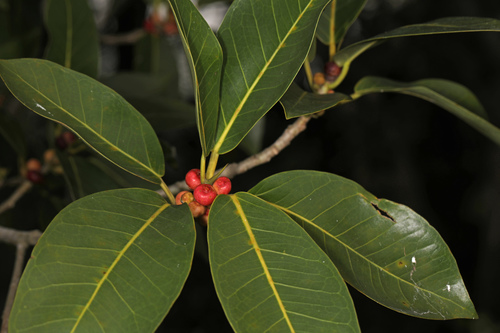
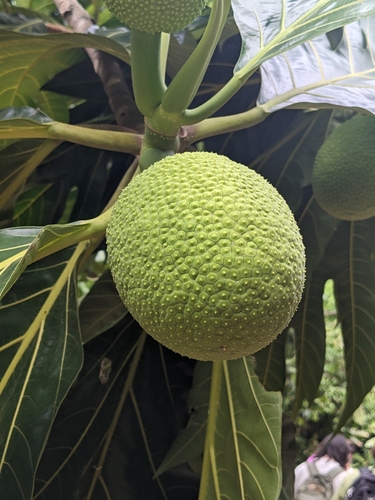
Breadfruit (Artocarpus altilis (Parkinson) Fosberg) trees reach up to 26 meters (85 feet) in height. They have large, thick leaves that are deeply cut into pinnate lobes. All parts of the tree produce latex, which is useful for caulking boats. The species is monoecious, meaning both male and female flowers grow on the same individual tree. Male flowers emerge first, followed shortly by female flowers. Female flowers develop into capitula, which are capable of pollination just three days after emerging. Pollination is mainly carried out by fruit bats, but cultivated varieties can produce fruit without pollination. The compound, false fruit develops from a swollen perianth, and originates from 1,500 to 2,000 individual flowers; these are visible on the fruit's skin as hexagon-like disks. Breadfruit is one of the highest-yielding food plants, with a single tree producing up to 200 or more grapefruit-sized fruits per season, and requires only limited care. In the South Pacific, trees produce 50 to 150 fruits per year; fruits are usually round, oval, or oblong, and weigh between 0.25 and 6.0 kilograms (0.55 to 13 pounds). Productivity varies between wet and growing areas. Studies conducted in Barbados indicate a reasonable potential yield of 15 to 30 tonnes per hectare (6.7 to 13.4 short tons per acre). The ovoid fruit has a rough surface, and each fruit is divided into many achenes; each achene is surrounded by a fleshy perianth and grows on a fleshy receptacle. Most selectively bred cultivars produce seedless fruit, while seeded varieties are grown mainly for their edible seeds. Breadfruit is typically propagated using root cuttings. Breadfruit is closely related to breadnut, and is similar in appearance to jackfruit (Artocarpus heterophyllus), its congener. The closely related Artocarpus camansi can be told apart from A. altilis by its spinier fruits that have numerous seeds. Artocarpus mariannensis can be distinguished by its dark green elongated fruits with darker yellow flesh, as well as entire or shallowly lobed leaves. Breadfruit is an equatorial lowland species. It spread from its native Pacific range to many tropical regions. In 1769, Joseph Banks was stationed in Tahiti as part of the Endeavour expedition commanded by Captain James Cook. In the late 18th century, the search for cheap, high-energy food sources for enslaved people in British colonies led colonial administrators and plantation owners to call for breadfruit to be introduced to the Caribbean. As president of the Royal Society, Banks offered a cash bounty and gold medal for success in this effort, and successfully lobbied for a British Naval expedition. After an unsuccessful 1789 voyage to the South Pacific to collect the plants as commander of HMS Bounty, William Bligh led a second expedition in 1791 with the ships Providence and Assistant. This expedition collected seedless breadfruit plants in Tahiti and transported them to St. Helena in the Atlantic, and to St. Vincent and Jamaica in the West Indies. The plant grows best at elevations below 650 m (2,130 ft), but has been found growing at elevations as high as 1,550 m (5,090 ft). It prefers neutral to alkaline soils with a pH of 6.1–7.4, which can be sand, sandy loam, loam, or sandy clay loam. Breadfruit can even grow in coral sands and saline soils. As an ultra-tropical species, it requires a temperature range of 16–38 °C (61–100 °F) and an annual rainfall of 2,000–2,500 mm (80–100 in). Breadfruit is a staple food in many tropical regions. Most breadfruit varieties produce fruit year-round. Both ripe and unripe fruit have culinary uses; unripe breadfruit is always cooked before consumption. Before eating, the fruit may be roasted, baked, fried, or boiled. When cooked, moderately ripe breadfruit has a taste described as potato-like, or similar to freshly baked bread. A single breadfruit tree can produce 200 kilograms (450 pounds) of fruit each season. Because breadfruit trees usually produce large crops at specific times of the year, preserving harvested fruit is a challenge. One traditional preservation technique used across Oceania is to bury peeled and washed fruits in a leaf-lined pit, where they ferment over several weeks to produce a sour, sticky paste. Stored this way, the product can remain edible for a year or more; some pits have been reported to contain edible contents more than 20 years after burial. For archaeologists studying the precontact history of French Polynesia, remnants of pit formations with scattered stones (presumed to have lined the pits) are often used as clues to identify prehistoric settlement. In addition to being eaten raw, breadfruit can be dried and ground into flour, and its seeds can be cooked for consumption. Pacific Islanders have long used breadfruit for a wide variety of purposes. Its lightweight wood, which has a specific gravity of 0.27, is resistant to termites and shipworms, so it is used as timber for structures and outrigger canoes. Its wood pulp can also be used to make paper called breadfruit tapa. Breadfruit wood was one of the most valuable timbers for building traditional houses in Samoan architecture. Breadfruit contains phytochemicals that have potential use as an insect repellent. Discarded parts of the fruit can be used to feed livestock, and breadfruit leaves can be browsed by cattle. When breadfruit is harvested, it exudes latex that sticks to surfaces and stains the fruit's epicarp. Proper breadfruit harvesting methods usually include a step to drain and dispose of this latex. The sticky white latex found in all parts of the tree has been used to make glue, as caulk, and even as chewing gum. Native Hawaiians used the sticky latex to trap birds, whose feathers were used to make cloaks.