About Arthrochilus huntianus (F.Muell.) Blaxell
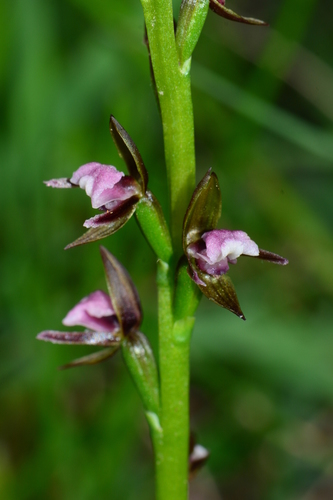
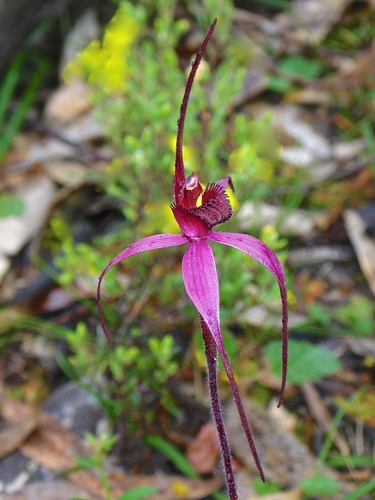
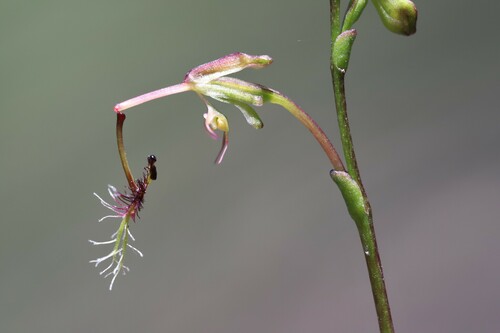
Arthrochilus huntianus, commonly known as the huntsman orchid, is a leafless, terrestrial, perennial, deciduous, sympodial herb. It grows from an underground tuber that produces daughter tubers at the tips of root-like stolons. Up to ten insect-shaped flowers, each 9–11 mm long and approximately 1.5 mm wide, grow on a thin, wiry flowering stem that ranges in color from green to reddish and stands 60–150 mm tall. Two, three, or four bracts are present at the base of the flowering stem. The dorsal sepal and petals are 3–4 mm long and about 1 mm wide, while the lateral sepals are 5–6 mm long and approximately 0.7 mm wide. All sepals and petals curve downwards toward the ovary. The labellum is 5–6 mm long and about 0.7 mm wide, attached to a thin stalk or "claw" that is 5–7 mm long. The labellum callus is shaped like an insect: it has a shiny black "head" with two antenna-like structures, a "thorax" covered in long purplish or reddish hairs, and a pair of long branched tails that bear tiny bristles. The column has two pairs of curved wings. Flowering takes place between November and March. This orchid grows in woodland and forest, most often in leaf litter. In New South Wales, it occurs mainly on the Great Dividing Range south of the Blue Mountains, and it is widespread across eastern Victoria. It was previously found on Flinders Island in Tasmania, but it is now considered extinct there. Like other orchids in the genus Arthrochilus, A. huntianus is pollinated by male thynnid wasps of the genus Arthrothynnus, though the specific wasp species involved has not been identified. It can also reproduce asexually by growing new tubers.