About Arthraxon hispidus (Thunb.) Makino
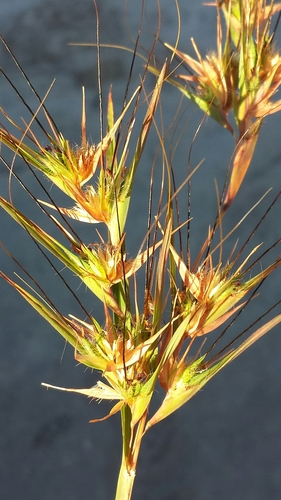
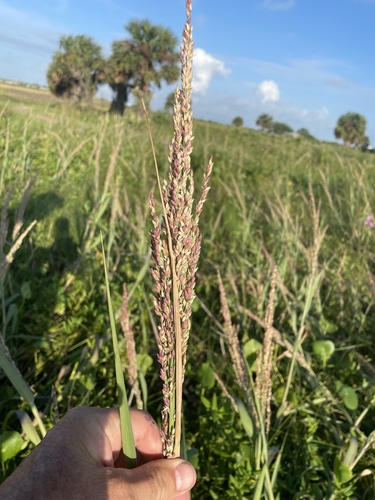
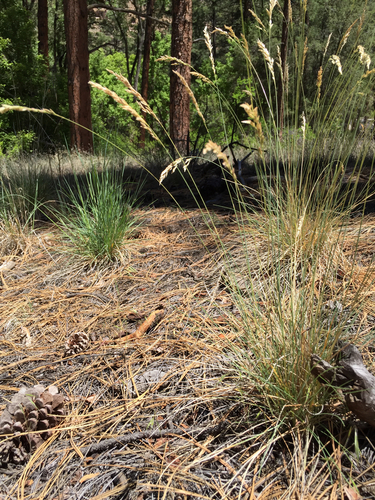
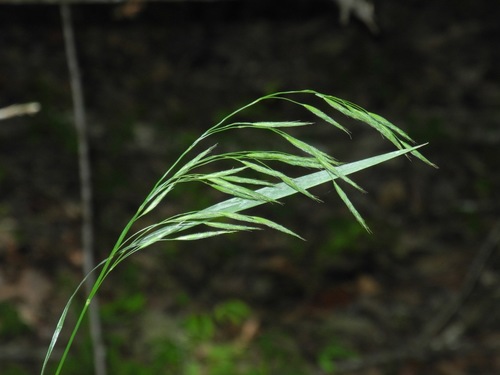
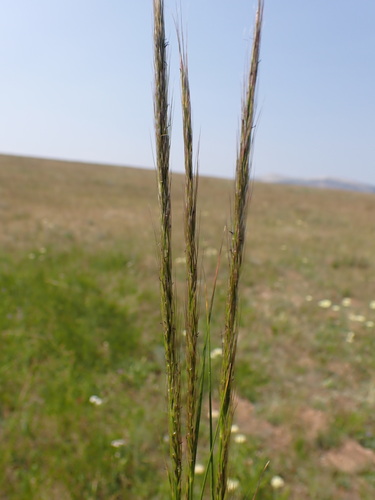
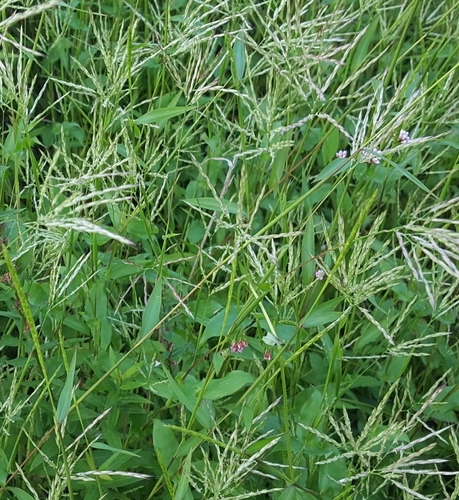
Arthraxon hispidus (Thunb.) Makino is an annual grass species. Its leaves are ovate or lanceolate with cordate bases, measuring 2.5 to 7.6 cm (1 to 3 inches) long and 0.5 to 1.27 cm (0.2 to 0.5 inches) wide. Both the leaf stems and leaf margins are covered in hairs. The plant grows 0.3 to 0.6 m (1 to 2 ft) tall, with hairless, upright stems. It can spread easily by rooting from stem nodes that come into contact with the ground. It produces fruit as caryopses, similar to other grain-type grasses; caryopses may have awns or lack them depending on the subspecies. Its flowering and fruiting period runs from September to November. The upper glume of this species is purple, while the lower glume is green. It is often confused with deertongue panicgrass (Dicanthelium clandestinum) and Oplismenus aemulus. It can be distinguished from D. clandestinum by its shorter overall height, shorter leaves, and the presence of hairs along leaf margins. It can be distinguished from O. aemulus by its digitate and subdigitate inflorescence. Arthraxon hispidus grows in moist, sunny environments, and is found in riparian, wetland, and floodplain habitats across Asia and Australia; in Australia it occurs specifically in New South Wales and Queensland. Seeds of this species are dispersed by water within its native habitat. Germination of A. hispidus is rapid, taking around three days, and has few limiting factors. During germination, the species tolerates a wide range of temperatures from 8 to 37 degrees Celsius, and pH levels from 5 to 10. It does not germinate well across a wide range of salinity levels, does not germinate well during drought conditions, and does not germinate well when buried more than 1 to 2 cm (0.4 to 0.8 inches) deep. Like other fire-adapted plants native to Australia, fire is thought to promote germination of this species. Fire is not a required disturbance for A. hispidus recruitment in Australia, but the species is believed to be resistant to variable weather patterns. In Asia, Arthraxon hispidus has a long history of use in traditional medicine and as a dye source. In traditional medicine, it is used to treat inflammatory conditions including asthma. The compound 7-methoxy-luteolin-8-C-β-6-deoxy-xylo-pyranos-3-uloside (mLU8C-PU) has been isolated from A. hispidus; like other luteolins, this compound may have value for treating tumor cells. This species is used to produce yellow silk cloth called kihachijo, a textile associated with Hachijo Island and Hachijo Island kimonos. The yellow dye color produced from this plant comes from identified flavonoid C-glycoside components: luteolin 8-C-rhamnoside, apigenin 8-C-rhamnoside, and tricin.