About Artemisia tridentata (Nutt.) W.A.Weber
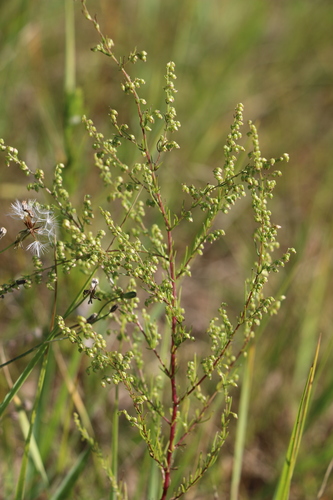
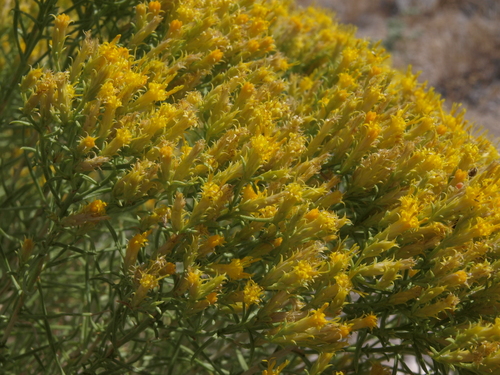
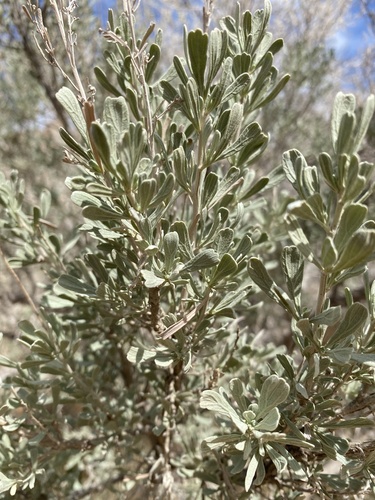
Artemisia tridentata, commonly called big sagebrush, is a coarse, many-branched pale grey shrub with yellow flowers and silvery-grey foliage. It typically grows between 0.5 to 3 meters (1½ to 10 feet) tall. It has a deep taproot that reaches 1 to 4 meters (3½ to 13 feet) in length, plus spreading shallow surface roots, which let it collect water from both surface rainfall and the water table several meters underground. Big sagebrush that grows taller than one meter indicates arable land, as the species prefers deep, basic soils. Once it passes the seedling stage, big sagebrush is generally long-lived and can reach over 100 years of age. The species produces a strong, pungent fragrance that is especially noticeable when wet, from camphor, terpenoids and other volatile oils. Its bitter taste and strong odor work together to discourage browsing by many herbivores. It is an evergreen shrub, and keeps some leaves year-round, though it sheds many of its leaves in late summer. Leaves grow attached to branches at axillary nodes; they are wedge-shaped, 1 to 3 centimeters (½ to 1¼ inches) long and 0.3 to 1 centimeter wide, with the wider outer tip divided into three lobes, which is the source of its scientific epithet tridentata. The leaf surface is covered in fine silvery hairs. The plant flowers in late summer or early fall, and its small yellow flowers grow in long, loosely arranged tubular clusters. Its fruits are seed-like and have a small amount of surface hairs. Big sagebrush can reproduce both from seed and through sprouts that grow up from underground rhizomes. Sprouts are extensions of the parent plant, while seedlings are entirely independent new individuals. Seedlings require more moisture for germination and early survival, because sprouts are connected to an already established healthy parent plant, while new seedlings must grow from scratch.
Artemisia tridentata grows in arid and semi-arid conditions across the Intermountain West of North America. It is not a desert plant, instead inhabiting steppe regions that receive 18 to 40 centimeters (7 to 15½ inches) of annual precipitation. Big sagebrush and other Artemisia species are the dominant vegetation across large portions of the Great Basin, covering roughly 422,000 square miles (1,090,000 square kilometers) across 11 western U.S. states and Canadian provinces. Its range extends north into the southern interior of British Columbia, south into Baja California, and east into the western Great Plains of New Mexico, Colorado, Nebraska, and the Dakotas.
Big sagebrush provides food and habitat for many animal species, including sage grouse, pronghorn, gray vireo, pygmy rabbit, and mule deer. It is particularly important for game animals during the winter. It also creates habitat for many species of grasses and herbs. In addition to providing shade and wind shelter, big sagebrush's long taproot brings water up from deep soil, making some of this water available to surrounding shallow-rooted plants. The terpenoid compounds in big sagebrush are thought to deter herbivores. At high concentrations, these oils are toxic to the symbiotic rumen bacteria of some ruminants such as deer and cattle. Pronghorn are the only large herbivores that browse sagebrush extensively. When grazing herbivores damage big sagebrush plants, the plants release volatile chemicals that act as a warning to nearby plants, triggering them to increase production of their own repellent chemical compounds. This plant-to-plant communication can work over distances of up to 60 centimeters (23½ inches).
Sagebrush ecosystems face several major threats: human settlements, conversion to agricultural land, invasive plant species, wildfires, and climate change. Because big sagebrush was the dominant shrub in these regions for long periods, many species have adapted specifically to this habitat. Burning sagebrush shrubs causes habitat loss for many adapted species and can be very harmful to the entire ecosystem. Additionally, destruction of native grasses and forbs from grazing and fire creates open conditions that allow invasive plants to colonize the area. The invasive species that has destroyed the largest amount of sagebrush habitat is cheatgrass (Bromus tectorum). Since its accidental introduction in the 1890s, cheatgrass has radically altered the native shrub ecosystem by replacing indigenous vegetation, and by creating a much more frequent fire cycle that does not allow sagebrush to re-establish. Big sagebrush is not fire tolerant, and relies on wind-blown seeds from outside the burned area to recolonize after fire. Some tree species have also encroached on big sagebrush habitat; for example, in the late 20th century, Abies concolor (white fir) out-competed big sagebrush in California's Warner Mountains.
The Cahuilla people historically gathered large quantities of big sagebrush seed, grinding it into flour. The main modern use of big sagebrush is as firewood, as its wood's oils are particularly flammable. The plant's active medicinal constituents are camphor, terpenoids, and tannins. It is used as a herbal medicine by Native Americans across the Intermountain West of North America, most commonly as a smudging herb. It is also used to prevent wound infection, stop internal bleeding, and treat headaches and colds. The Navajo use big sagebrush vapor as a treatment for headaches. The Okanagan and Colville people used big sagebrush to smoke hides. Among the Zuni people, an infusion of the leaves is used externally for body aches, and taken internally as a cold medicine. It is also placed in shoes to treat athlete's foot, fissures between the toes, and as a foot deodorant.