About Artemisia tilesii Ledeb.
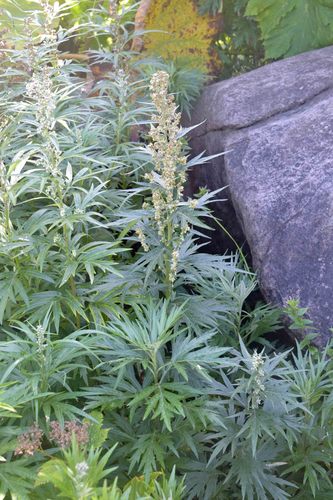
Artemisia tilesii Ledeb. is a perennial herb that grows from a tough rhizome. It produces between one and three stems that reach a maximum height of 80 centimeters. The stems may appear white from a coating of woolly hairs. Leaves and inflorescences of this species are quite variable, and the species is sometimes split into multiple subtaxa based on these differences. Its leaves are often bicolored, with white and green coloration created by the distribution of hairs across their surfaces. The inflorescence can be small and compact, or wide, open, and branching. Each bell-shaped flower head is roughly half a centimeter long, lined with purplish phyllaries, and holds many yellow flowers. This plant is aromatic. Its scent inspired the common name "stinkweed", though some people find the scent agreeable. The scent can be mild, or strong enough to mask the smell of fish. In experiments, the leaves of this plant neutralized simulated acid rain droplets; this effect may come from the presence of various cations such as calcium. The cultivar 'Caiggluk' was developed in Alaska for revegetation and erosion control work. This cultivar tolerates a wide range of soil pH levels, and can grow on waste land that has been made toxic by mining operations. It is easy to grow and has an attractive appearance. Caiggluk is the Yupik name for the wild form of this plant. The Iñupiaq names for this plant are Sargiġruaq and Salgiġruaq. Artemisia tilesii has a number of historical uses in the traditional medicine systems of Alaska Native peoples. It has been used to treat fever, infection, tumors, arthritis and other joint pains, bleeding, congestion, and tuberculosis, and also used as a laxative and a general tonic. Native Alaskans also used A. tilesii as a deodorizer after preparing fish. It was used in steambaths and sweat lodges. Native Alaskans also chewed it alongside tobacco, and ate its roots with seal oil.