About Artemisia selengensis Turcz. ex Besser
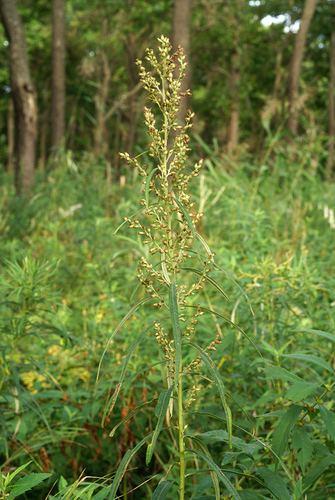
Artemisia vulgaris, commonly called mugwort, is an aromatic, herbaceous perennial plant that reaches up to 1.5 meters (4 feet 11 inches) in height. It spreads through vegetative growth and human-caused dispersal of broken rhizome fragments. In temperate regions, the plant rarely reproduces from seed, because it produces very few viable, germinating seeds. Ploughing cannot easily control mugwort: when soil is disturbed, rhizome sections separate from the parent plant, leading to an increase in the number of new plants. Stems are purple-tinged and angular. Mature pinnate leaves are dark green and glabrous (smooth) on the upper surface, with dense whitish tomentose hairs on the underside. Leaf lobes are roughly 2.5 to 8 millimeters (0.098 to 0.315 inches) wide. New leaves are opposite, attached to the stem with a long thin petiole, rounded, unlobed, and woolly on the underside. Yellow or reddish flower heads develop from July to September, arranged in a paniculate branching structure. They are 5 millimeters (3⁄16 inch) long and radially symmetrical, with female outer flowers and bisexual inner flowers per capitulum; flowering occurs from midsummer to early autumn. The fruit is brown, rectangular, single-seeded, marked with ridges, has a narrow base, and bears tiny bristles at its tip. The root system is made up of many branched horizontal rhizomes that produce adventitious roots. Up to 20 new stems can grow from a single root system. The main brown woody root reaches roughly 200 millimeters (7.9 inches) in length, with rootlets 51 to 102 millimeters (2.0 to 4.0 inches) long and approximately 2 millimeters (0.079 inches) thick. In her 1931 work A Modern Herbal, Margaret Grieve described the taste as "sweetish and acrid", and contact with the plant or drinking beverages made from it is thought to cause dermatitis. Artemisia vulgaris is native to temperate Europe, Asia, North Africa, and Alaska, and has become naturalized in North America, where it is often considered an invasive weed. It is a common species that grows in low-nitrogen soils, including wastelands, roadsides, and uncultivated areas. It prefers alkaline conditions and readily establishes itself in open, sandy ground. The species reproduces mainly via rhizomes, as it rarely produces viable seed in temperate regions, and ploughing does not effectively control it because disturbed rhizome fragments separate from the parent plant to grow new plants, increasing population size. Several species of Lepidoptera (butterflies and moths), including Ostrinia scapulalis, feed on the plant's leaves and flowers. It may be susceptible to attack by honey fungus. In the Middle Ages, mugwort was known as Cingulum Sancti Johannis, because it was believed that 1st-century preacher John the Baptist wore a girdle made from the plant. Per Grieve, mugwort was thought to protect travelers from exhaustion, heatstroke, and wild animals, and it was worn on St. John's Eve to protect against evil spirits. Before hops were introduced to beer production, A. vulgaris was commonly used as a flavoring agent in England. Dried mugwort flowers were added to malt liquor, which was then mixed into beer. Mugwort was used as a traditional flavoring and bittering agent for gruit ales, a type of unhopped fermented grain beverage. It is used as an aromatic culinary herb in both Vietnam and Germany. In China, the crunchy stalks of young A. vulgaris shoots are a seasonal vegetable commonly used in stir fries. In Nepal, the plant is used as an offering to gods, for environmental cleansing through sweeping floors or hanging bundles outside the home, as incense, and as a medicinal plant. Dried leaves can be smoked or brewed into tea to promote lucid dreaming; this claimed oneirogenic effect is said to come from the thujone the plant contains. Historically in the Middle Ages, A. vulgaris was called the "mother of herbs" and was widely used in traditional Chinese, European, and Hindu medicine. It is claimed to have a wide range of pharmacological properties, including anticancer, anti-inflammatory, antioxidant, hepatoprotective, antispasmolytic, antinociceptive, antibacterial, antihypertensive, antihyperlipidemic, and antifungal effects.