About Artemisia rigida (Nutt.) A.Gray
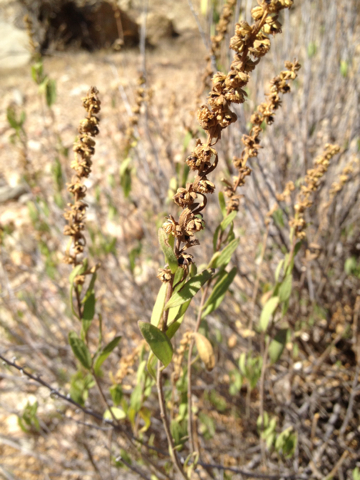
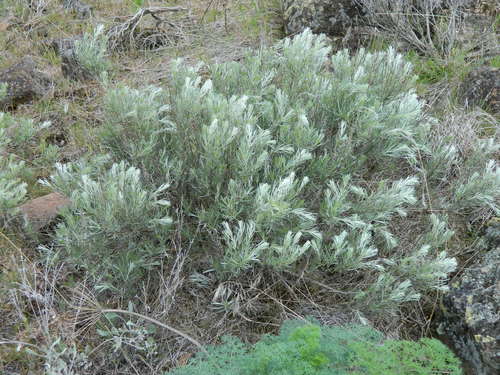
Artemisia rigida is a small, spreading deciduous shrub that produces many woody branches reaching up to 40 centimeters in length. When young, the stems often have a reddish color; as they mature, they turn gray and develop a hairy texture. Its leaves grow up to 4 centimeters long, are trident-shaped, and appear grayish, covered in a coat of silvery hairs. This differs from the similar species Artemisia tripartita, whose leaves typically bear shorter woolly hairs. Artemisia rigida has a scent that ranges from mild to pungent. Its flower heads are somewhat bell-shaped, measure around half a centimeter wide, and hold between 4 and 8 yellow-red to red florets. This species grows in harsh substrates where very few other plants can survive. It is almost always found in very shallow soil overlying bedrock that is always basalt, never granite. Its roots remain within the shallow soil layer, with some roots anchoring into rock fractures. An impermeable clay layer is sometimes present in these substrates. The substrate that Artemisia rigida occupies commonly undergoes frost heaving, which breaks the material apart. On these unproductive sites, such as the Channeled Scablands, Artemisia rigida is a climax species, and serves as an indicator of scabland habitat. In the Columbia Basin, it often dominates areas with thin rocky soils. Its primary associated understory species is Sandberg's bluegrass, which grows alongside various low herbaceous plants including Viola trinervata and small Lomatium species. Because it is often the only plant exposed when snow melts in spring on largely barren landscapes, Artemisia rigida provides food for wildlife. Livestock also favor the plant, particularly its seedheads.