About Artemisia pygmaea A.Gray
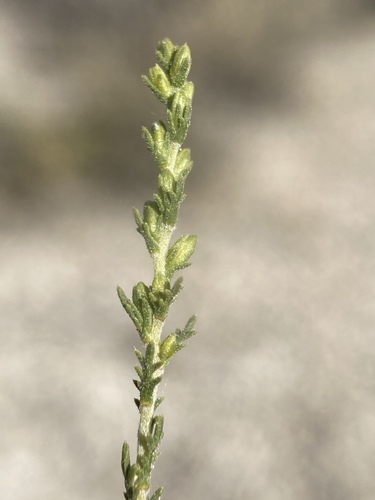
Artemisia pygmaea A.Gray is a small, cushion-like woody shrub that grows from a taproot, reaching up to around 20 centimeters (8 inches) in height. Its small leaves are less than one centimeter long and wide, and are either toothed or divided into several deep lobes. The plant's flower heads hold 3 to 5 disc florets and do not produce any ray florets. It is dioecious, meaning male and female flowers grow on separate individual plants. Blooming takes place in August and September. This species is one of several host plants parasitized by the parasitic plant Orobanche fasciculata. This sagebrush species is native to areas of the Southwestern United States, including parts of Nevada, Utah, Colorado, Arizona, and New Mexico. It is uncommon across most of its range, but can be abundant in specific local areas. It grows in very dry habitat types, occurring in desert grasslands, pinyon-juniper woodlands, and playas of the American southwest, particularly in the Great Basin and Uinta Basin. It prefers calcareous soils like gypsum, along with alkali soils, salty soils, and clay. It can grow successfully in substrates that support very few other plant species. Its small size is an adaptation to its dry habitat.