About Artemisia norvegica Fr.
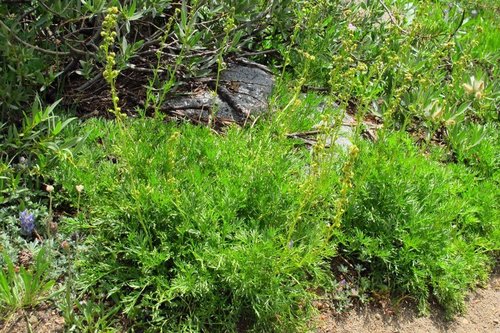
Artemisia norvegica Fr. is a perennial subshrub that reaches 20 to 60 centimetres (7.9 to 23.6 inches) in height. It produces erect stems that grow from a caudex and taproot. Most of its leaves grow low on the stems and measure 2 to 20 centimetres (0.79 to 7.87 inches) long. Its nodding inflorescence holds flower heads that contain both ray and disc florets: the ray florets are female, with no functional male parts, while the central disc florets are bisexual. This plant reproduces via seed, and may also spread vegetatively through growing stolons. Its seeds are dispersed by wind. This species grows in subalpine, alpine, and Arctic habitats including tundra. It can be found in moraines, fell field, alpine meadows, and areas dominated by grasses and sedges. In Alaska, it grows on the fjords of Prince William Sound alongside larkspur monkshood (Aconitum delphiniifolium), Eschscholtz's buttercup (Ranunculus eschscholtzii), and Canadian burnet (Sanguisorba canadensis). On Alaskan mountains like the Kenai Mountains, it grows with grasses, sedges, and willows. In the alpine tundra of the Rocky Mountains, it grows in snowbeds and on turf formed by blackroot sedge (Carex elynoides) and alpine clover (Trifolium dasyphyllum). In the mountains of the Northwest Territories, it occurs among lichens and grasses including arctic bluegrass (Poa arctica). A number of animals feed on Artemisia norvegica: in Alaska, mountain goats eat it during the summer, and it is also consumed by Sitka black-tailed deer and hoary marmots. This species acts as a pioneer species during the primary phase of ecological succession in disturbed areas, such as flood-scoured plains. It is known to colonize denuded soil in vehicle tracks, and was used to revegetate habitat disturbed during the construction of Trail Ridge Road in Colorado.