About Artemisia japonica Thunb.
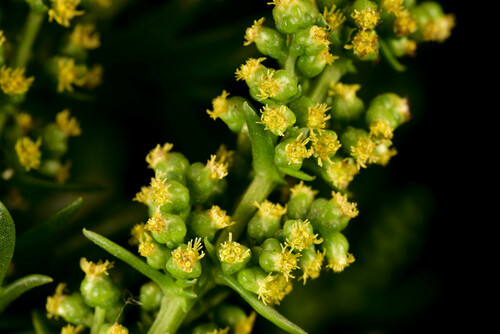
Artemisia japonica Thunb. is a perennial herb that grows 50 to 130 centimeters tall. It has a thick, woody rootstock with a strong scent. Leaves are clustered at the plant’s rounded apex; leaf blades are spatulate, ranging from oblong-obovate to broadly spatulate or flabellate. This species produces many nodding, ovoid or subglobose capitula, each holding 12 to 15 yellow bisexual florets that contain both male and female structures. Its achenes are brown and obovoid. Flowering occurs from August to November, and the species is most commonly encountered during August, September, and October. Of all recorded occurrences, 82.3% are preserved specimens, while 17.0% are direct human observations. It is most commonly found in China, Japan, and Korea. Four varieties are recognized: Artemisia japonica var. hainanensis, native to China; Artemisia japonica var. hallaisanensis, native to Korea; Artemisia japonica var. japonica, native to Japan; and Artemisia japonica var. manshurica, native to Northeastern China. In ecology, the parasite Globodera artemisiae, which is commonly found on Artemisia vulgaris, was first discovered infecting Artemisia japonica in September 2020. In Ladakh and Lahoul, India, sheep and goats graze on this plant, but yaks in the region do not prefer it. For uses, the young leaves of Artemisia japonica are cooked and eaten. Mature leaves are used as a digestive aid. Excessive consumption of a leaf decoction can cause hypertension. Plant juice is used to treat vaginitis and skin diseases. Dried plant powder is used as incense. The species is used to produce antitoxifying and antifebrile medications. In a study of artemisinin production across Artemisia species, A. japonica contained roughly average artemisinin levels compared to other species, ranging from 0.05% to 0.15% artemisinin. Its flowers also contain more artemisinin than its leaves.