About Artemisia douglasiana Besser
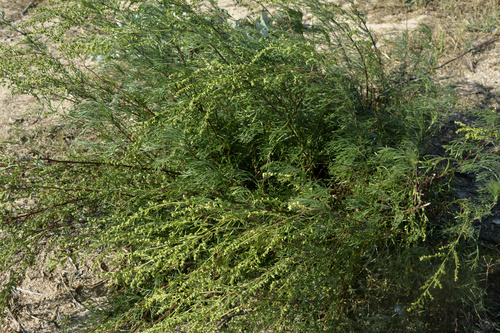
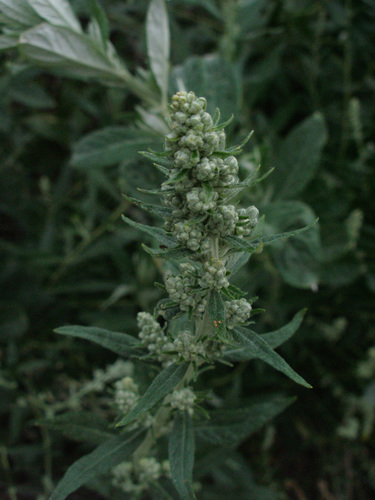
Artemisia douglasiana Besser is a dicotyledonous perennial forb. Its stems grow from a large colony of rhizomes, which need at least 16 cm of soil depth, and can grow in soils ranging from fine to coarse texture. The stems are erect, and reach heights between 0.5 and 2.5 metres (1.6 to 8.2 ft). Its grey-green leaves are evenly spaced, elliptical, and lobed at the tips. The 3 to 5 lobes at the leaf tips can range from barely noticeable to clearly defined. The leaves of this species contain thujone and cineole. Its blooming period runs from May to October, during which it produces bell-shaped flower clusters. Each cluster holds 5 to 9 pistillate flowers and 6 to 25 disk flowers. While Artemisia douglasiana can reproduce by seed, it is primarily propagated through the division and spreading of its underground rhizomes. Its extensive rhizomes prevent erosion by stabilizing streambanks. This species is susceptible to infection by Xylella fastidiosa, the bacterium that causes Pierce's disease. This herbaceous perennial is native to the Western United States, specifically California, Idaho, Nevada, Oregon, and Washington, as well as northwestern Baja California, Mexico. It prefers full sunlight and moist soils, but can tolerate shady areas and dry soils. It grows in hardiness zones 6a through 10b, and occurs at elevations from 0 to 3080 meters. It is commonly found growing in ditches and along streambanks. A variety of native birds forage for its seeds, and some native bees use its leaves as nesting material. Native American tribes use Artemisia douglasiana as a medicinal plant: it relieves joint pain and headaches, treats abrasions and rashes including poison ivy, and addresses women's reproductive issues including irregular menstruation. It is also occasionally used as an abortifacient. For many Native American tribes, this plant serves ceremonial and spiritual purposes. It is commonly carried to ward off the spirits of the dead, and it is smoked or brewed into tea to induce vivid dreams. Contemporary herbalists also plant it for both medicinal and spiritual uses. Artemisia douglasiana is cultivated as an ornamental plant by specialty native plant nurseries, and is planted in wildlife gardens, natural landscaping, habitat restoration projects, and erosion control projects.