About Artemisia cana Pursh
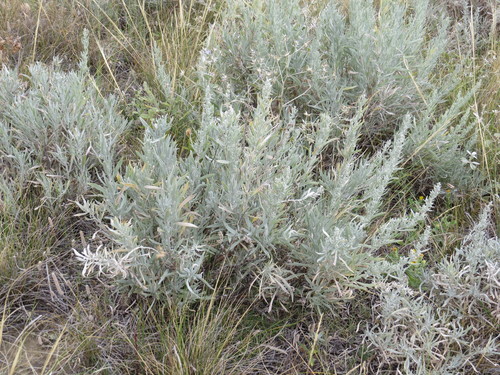
The type specimen of Artemisia cana was first informally described by collector Meriwether Lewis, who gathered it on October 1, 1804, near Centinel Creek in South Dakota during the Lewis and Clark Expedition. Lewis's description was published in the 1904 edition of Original Journals of Lewis and Clark edited by Thwaites: On these hills many aromatic herbs are seen; resembling in taste, smell [sic] and appearance, the sage, hyssop, wormwood, southernwood and two other herbs which are strangers to me the one resembling camphor in taste and smell, rising to the height of 2 or 3 feet; the other about the same size, has a long narrow, smooth, soft leaf of an agreeable smell [sic] and flavor; of this last the antelope is very fond; they feed on it, and perfume the hair of their foreheads and necks with it by rubbing against it. Artemisia cana, commonly called silver sagebrush, is an aromatic shrub. It generally reaches 50–150 centimetres (20–59 in) in height; specimens west of the Continental Divide are typically shorter than those growing east of the divide. It has evergreen, narrow, grey-green leaves with a distinct aroma. This species is native to the Canadian provinces of British Columbia, Alberta, Saskatchewan and Manitoba, and the American states of Alaska, Oregon, California, Idaho, Nevada, Utah, Arizona, Montana, Wyoming, Colorado, New Mexico, North Dakota, South Dakota, Nebraska and Minnesota. It grows in rocky open grasslands, floodplains, and montane forests.