About Artemisia californica Less.
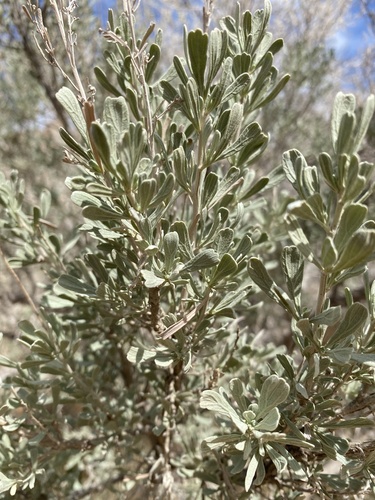
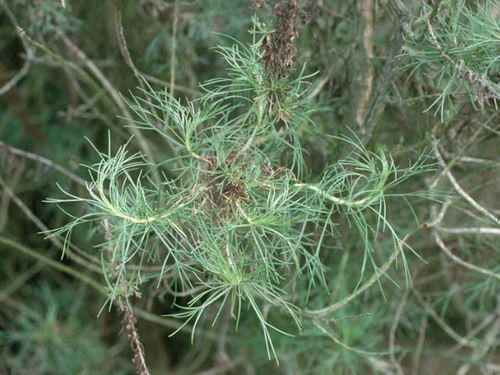
Artemisia californica Less. is a member of the sunflower family (Asteraceae). This shrub branches from its base and grows outward to form a rounded shape, reaching 1.5 to 2.5 metres (5 to 8 feet) tall, or roughly 4 feet tall and 4 feet wide when planted in full sun. Its stems are slender, flexible, and either glabrous (hairless) or canescent (fuzzy). Leaves are 1 to 10 centimetres (1⁄2 to 4 inches) long, pinnately divided into 2–4 threadlike lobes less than 5 cm long. Leaves are hairy, light green to gray in color, and their margins curl under. The inflorescences are leafy, narrow, and sparse. The capitula are less than 5 millimetres (3⁄16 in) in diameter. There are 6 to 10 pistillate flowers and 15 to 30 disk flowers, which are generally yellowish but sometimes red. Like other members of the genus Artemisia, it often produces small, unnoticeable blooms; its most notable feature for gardens is its attractive silvery, often fragrant foliage when crushed. The pleasant scent of its stems and leaves comes from essential oils, which also deter animal and insect pests. It flowers late in the season, making it an important food source for local wildlife. The genus Artemisia is widespread across the Old and New Worlds, and many species have been used for hundreds of years in horticulture, cooking, and medicine across Europe, Asia, and the Americas. Due to its common name and sage-scented leaves, Artemisia californica is often called California sagebrush, and is sometimes mistaken for a true sage (Salvia). It produces resinous achenes up to 1.5 mm long, with a pappus that forms a minute crown on the achene body. It contains terpenes that give it a strong aroma, which many people find pleasant. California sagebrush is native to western California and northwestern Baja California. It is endemic to the California chaparral and woodlands ecoregion, where it grows in coastal sage scrub, coastal strand, chaparral, and dry foothill communities, from sea level up to 800 m (2,600 ft) in elevation. It also grows on many islands off the Baja California peninsula, including the Coronado Islands, Cedros Island, and Guadalupe Island in the Pacific Ocean. Its prototypical plant association is chaparral, particularly in the California Coast Ranges; toyon and sage are also key members of communities that transition between chaparral and coastal sage scrub. It is often reported to be allelopathic, secreting chemicals into the soil that inhibit the growth of other plants nearby. It is a critical component of coastal sage scrub habitat, and is widely used in coastal sage scrub restoration projects. In cultivation, it is grown as an ornamental plant in native plant gardens, wildlife gardens, and natural landscaping, as well as for restoring disturbed sites and degraded coastal sage scrub. Several lower-height cultivars are available in the horticultural trade for use as drought-tolerant groundcover. It thrives in full sun, and prefers growing on west or north-facing slopes. It needs very little water, and prefers no added water during summer months; soil type does not appear to have much effect on its growth. It relies on wildfire for seed germination, and already established burned plants can crown-sprout and continue growing. Animals rarely eat this plant, most likely because of its bitter aromatic terpenes, but it provides excellent cover for small birds and other animals that can fit between its stems. It is an important habitat plant for the endangered California gnatcatcher. Once established, it can survive without additional water, though it looks healthier when watered occasionally during deep summer. Its finely split gray leaves create a pleasant contrast against lush green vegetation in gardens. Multiple Chumashan linguistic groups have different names for this species: Barbareño calls it we'wey, Cruzeño and Inseño call it wewey, Obispeño calls it tilho, and Ventureño calls it wewe'y. The Chumash people used this plant for many recreational, ritual, and medicinal purposes: stems were used to kindle fire and make arrows, while leaves and branches were used as incense and disinfectants for funeral rituals. The Cahuilla people chew its dried or fresh leaves to treat coughs and colds. Both the Cahuilla and Tongva peoples use it to ease menstrual cramps and labor, as it stimulates the uterine mucosa to speed up childbirth. The Ohlone people use it for pain relief by applying leaves to wounds or aching teeth. Medicinally, Artemisia californica can be made into a decoction that relieves menstrual cramps and menopause symptoms when taken regularly before menstruation. It can also be prepared as a tea bath to treat colds, coughs, and rheumatism, or as a poultice to help with asthma. Its aromatic properties make it useful for incense and perfumes. It is also used to make a liniment that acts as a powerful pain reliever. The monoterpenoids in the plant interact with transient receptor potential cation channels to relieve pain, and the plant also contains sesquiterpenes that may contribute to pain relief. This liniment is reported to be more powerful than opioid drugs and much safer. A small amount of liniment applied to the affected area will relieve pain within 20 minutes, even pain from broken bones, arthritis, sprains, and strains.