About Artemisia caerulescens L.
This entry focuses on the large, diverse genus Artemisia, which belongs to the daisy family Asteraceae and contains almost 500 species, including the species Artemisia caerulescens L. Common names for species across this genus include mugwort, wormwood, and sagebrush. While some botanists have proposed splitting the genus into multiple separate genera, DNA analysis does not support keeping the proposed genera Crossostephium, Filifolium, Neopallasia, Seriphidium, and Sphaeromeria as separate groups. DNA evidence does support keeping three other proposed segregate genera: Stilnolepis, Elachanthemum, and Kaschgaria. Occasionally, Artemisia species are called sages, which causes confusion with Salvia sages that belong to the mint family Lamiaceae.
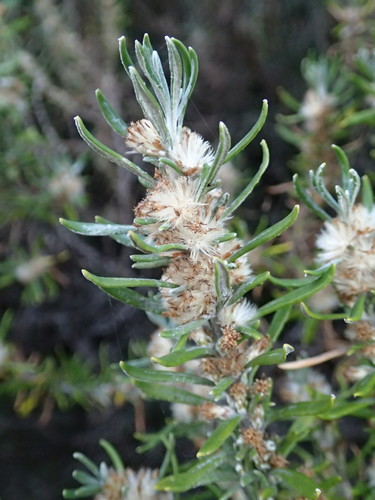
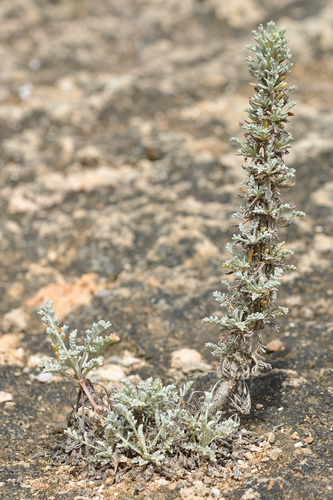
Artemisia consists of hardy herbaceous plants and shrubs, well known for the powerful chemical constituents found in their essential oils. Most species have strong aromas and bitter tastes from terpenoids and sesquiterpene lactones, which discourage herbivory and may have provided a selective advantage. The leaves of many Artemisia species are covered with white hairs. The genus produces small wind-pollinated flowers. Artemisia species grow in temperate climates of both hemispheres, typically in dry or semiarid habitats, and can be found on every continent except Antarctica. Artemisia species act as food plants for the larvae of many Lepidoptera species, and have become integrated into many ecosystems around the world.
In cultivation, most Artemisia species grow best in free-draining, unfertilized sandy soil and full sun. A few species are grown as ornamental plants, and fine-textured varieties are often used for clipped bordering. The largest collection of living Artemisia species, subspecies, and cultivars is the National Collection of Artemisia in Sidmouth, Devon, UK, which holds around 400 taxa. This collection is part of the National Collection scheme administered by Plant Heritage, formerly the National Council for Conservation of Plants and Gardens (NCCPG), in the British Isles.
The aromatic leaves of some Artemisia species are used for flavoring. Most species have an extremely bitter taste. Artemisia dracunculus, commonly known as tarragon, is widely used as a culinary herb and is particularly important in French cuisine. Artemisia vulgaris (common mugwort) was historically used to repel midges, fleas, and moths, expel intestinal worms, and added to home brewed mugwort beer and mugwort wine as a remedy for hangovers and nightmares; the Old English name mucgwyrt appears to derive from mycg, meaning midge. Artemisia absinthium (wormwood) is used to make the highly potent spirit absinthe, and wormwood is also an ingredient in the bitter liqueur Malört. The aromatic aperitif vermouth is a wine flavored with a blend of aromatic herbs, and was originally flavored with wormwood. Artemisia arborescens, known as tree wormwood or sheeba in Arabic, is an aromatic herb native to the Middle East, commonly used to make tea, usually blended with mint.
For medicinal use, artemisinin (a compound from Artemisia annua) and its derivatives form a group of compounds used to treat malaria. Artemisinin-combination therapies, which include an artemisinin derivative, are now the standard worldwide treatment for malaria caused by Plasmodium falciparum. Some research suggests administering dried whole leaves of Artemisia annua may lead to slower development of resistance than treatment with pure artemisinin. Tu Youyou received the 2015 Nobel Prize in Physiology or Medicine for her work discovering semisynthetic artemisinin derivatives. Her research built on traditional Chinese medicine, drawing from folk medicine and ancient Chinese texts. By reviewing these ancient texts, her team found that artemisinin is best extracted at lower temperatures, because pouring high-temperature water over sweet wormwood leaves destroys the plant's active treatment properties. The World Health Organization does not support promoting or using any form of Artemisia plant material to prevent or treat malaria, noting several issues with the plant-based form of medication. These problems include inconsistent artemisinin content, low enough content that malaria recurrence is common, the possibility that widespread use of whole plant material contributes to artemisinin resistance, and that whole plant Artemisia is not effective for malaria prevention.