About Artemisia biennis Willd.
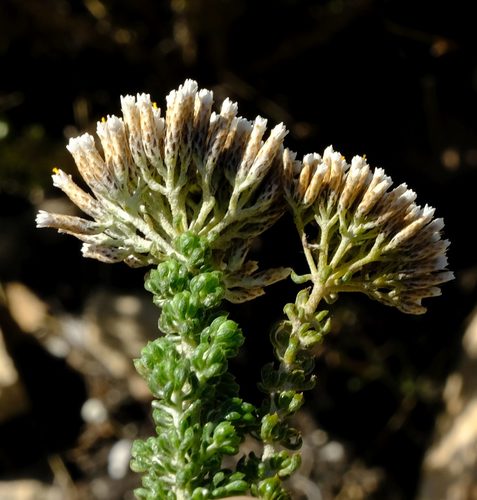
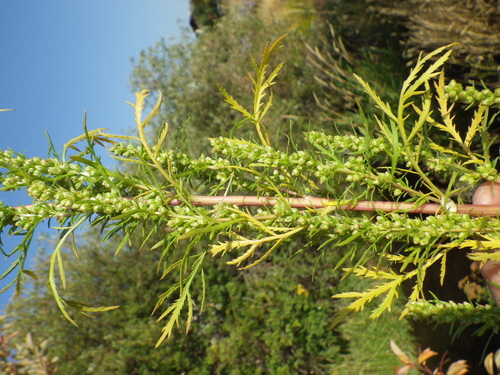
Artemisia biennis Willd. is an annual or biennial herb that grows one erect green to reddish stem, reaching a maximum height of 2 metres (6 ft 7 in). The plant is generally hairless and unscented; unlike other species in its genus, crushing its leaves or stem produces no odor. It typically grows as a narrow, spire-shaped plant. Its alternate leaves are frilly, up to 13 centimetres (5.1 in) long, and deeply divided into long, narrow, lance-shaped segments with toothed edges; lower leaves are often doubly divided. The inflorescence is a dense rod-like structure of small, densely packed columnar clusters of flower heads, interspersed with leaves. The numerous globe-shaped flowers range in color from green to yellow. The fruit is a tiny achene less than 1 millimeter wide. This species blooms between August and October. It can be confused with Artemisia annua, but A. annua has a scent while A. biennis does not. The seeds of this plant have been eaten, though they are often very small and difficult to harvest and use. It has been used internally to treat stomach cramps, colic, and painful menstruation, and externally to treat sores and wounds. Available reports do not specify which parts of the plant are used for these medicinal treatments. When mixed with molasses, the seeds have been used to kill internal parasitic worms.