About Artemisia arborescens L.
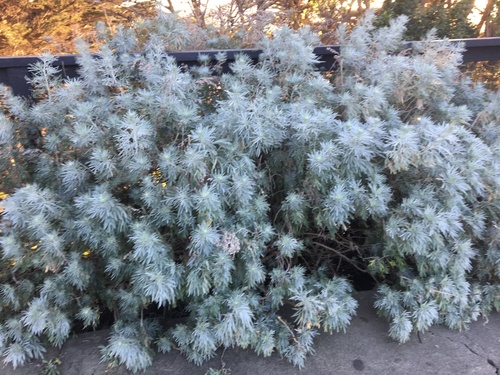
Artemisia arborescens, commonly called tree wormwood, is a flowering plant species in the Asteraceae family, native to the Mediterranean region. It is an erect evergreen perennial, grown with masses of finely divided aromatic silvery-white leaves and single-sided sprays of yellow daisy-like flowers. This species is cultivated for its ornamental foliage effect, but needs protection from a wall when grown in colder temperate regions. Its specific epithet arborescens translates to "woody" or "tree-like". Both the species itself and its cultivar 'Powis Castle' have received the Royal Horticultural Society's Award of Garden Merit. 'Powis Castle' is a relatively compact cultivar, and unlike typical Artemisia arborescens, it rarely produces flowers. It carries a strong sweet scent that is distinct from that of standard A. arborescens. While it has been hypothesized to be a hybrid between A. arborescens and A. absinthium, it is more likely a naturally occurring form from the Middle East, where populations of arborescens and absinthium are known to intergrade. The origin of the cultivar is not clearly documented, but around 1968 British gardener Jim Hancock took a cutting from a plant he discovered growing during a garden visit in Yorkshire. When he became Head Gardener at Powis Castle in 1972, he brought the cutting to the site. The cultivar was later named after this garden, propagated, and sold to help promote National Trust gardens. Like other species in the genus Artemisia, A. arborescens produces essential oils that have been used for various medicinal purposes throughout history, and its pharmacological properties are currently the subject of ongoing research. It also has culinary uses: it is used as a substitute or supplement for spearmint in Maghrebi mint tea during the winter, when fresh mint is out of season, and it adds a bitter flavor to the drink.