About Artemisia annua L.
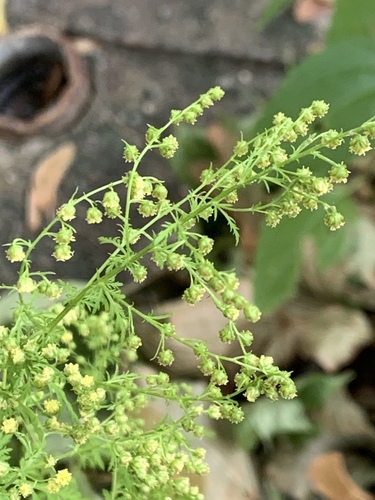
Artemisia annua L. is an annual short-day plant in the Asteraceae plant family. It has an erect stem that is brownish or violet-brown. The entire plant is hairless; wild individuals naturally grow 30 to 100 cm tall, while cultivated plants can reach up to 200 cm in height.
The leaves of A. annua are 3–5 cm long, deeply cut into two or three small leaflets, and have a characteristic strong aromatic scent. The artemisinin content of dried A. annua leaves ranges from 0% to 1.5%. New hybrids of the species developed in Switzerland can have a leaf artemisinin content as high as 2%. Four additional new genotypes with 2% leaf artemisinin, developed through a collaboration between the USDA and Purdue University, have been released to researchers working on artemisinin production.
A. annua produces small greenish-yellow flowers, 2–2.5 mm in diameter, arranged in loose panicles. Its seeds are brown achenes only 0.6–0.8 mm in diameter, with an average thousand-kernel weight (TKW) of around 0.03 g. For comparison, wheat has an approximate TKW of 45 g.
In traditional Chinese medicine (TCM), A. annua is prepared with water to treat fever. Due to name duplication in ancient TCM sources, A. annua is more commonly called qinghao (Chinese: 青蒿; pinyin: qīnghāo) — the modern Chinese name for Artemisia carvifolia — rather than its own current Chinese name huanghuahao.