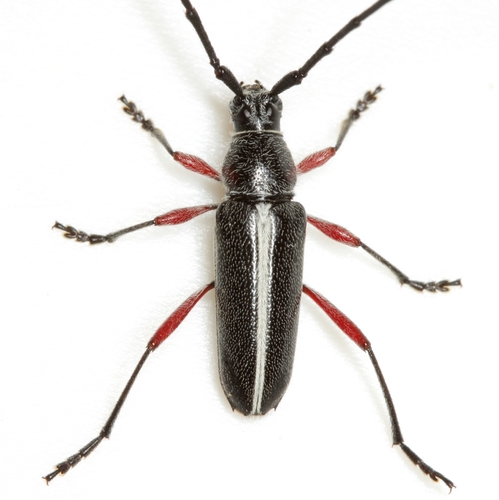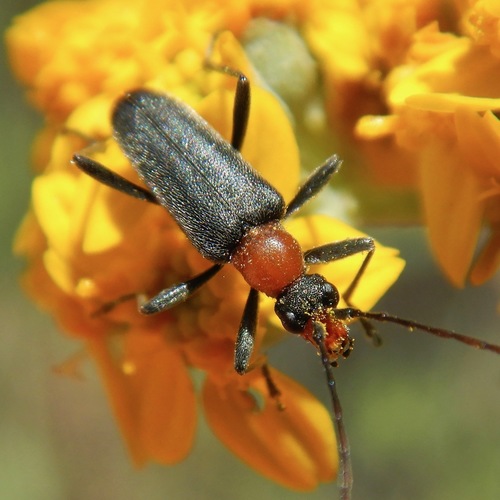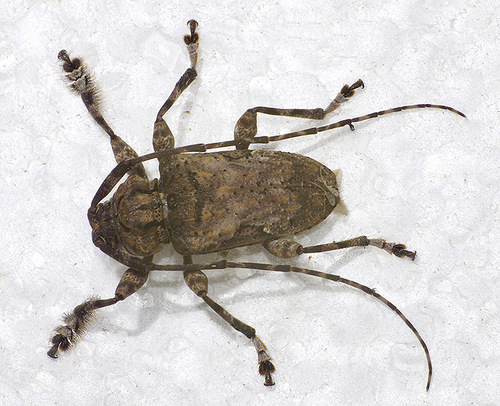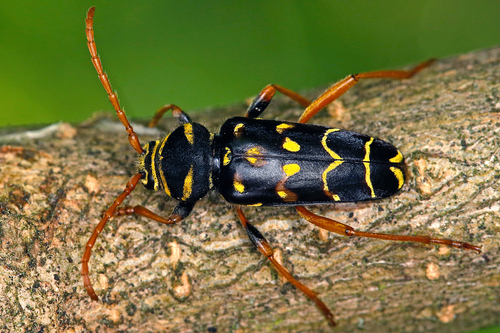
About Aromia bungii (Faldermann, 1835)
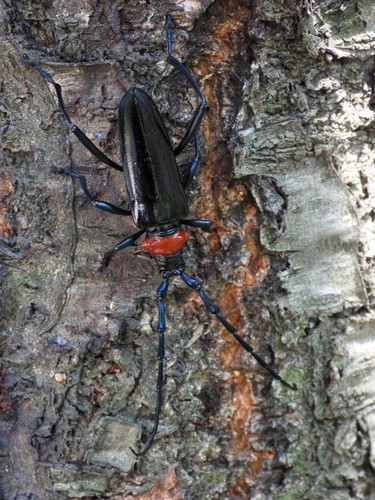
Adult Aromia bungii beetles are typically around 30 mm long when excluding their antennae and long legs, with an overall size range of 20 to 40 mm. They can be identified by a characteristic combination of shiny black elytra and a red pronotum, though an entirely black color form also exists. The species most similar to Aromia bungii is Aromia moschata, which is widespread across Europe and can also have color forms with a red pronotum. The most reliable difference between the two species lies in the structure and color of the elytra: A. bungii have black, shiny, smooth elytra, while A. moschata elytra have an uneven surface, with a metallic greenish, bluish or reddish-brown color (black is rare). Additionally, A. moschata elytra have two fine ridges that run from the base to the distal half of the wing. Other diagnostic features for adult Aromia bungii include antennae with a furrow on the first segment, and ridges on the third and all subsequent segments. Female antennae are roughly as long as the beetle's body, while male antennae are almost twice as long as the body. The pronotum of A. bungii has an uneven surface marked by several swellings and humps, and its sides are pointed. The tibiae of the hind legs are flattened along their sides. Identifying larval Aromia bungii is important for quarantine purposes in regions where this species is invasive. The larval head has distinctive features that separate it from the larvae of other longhorn beetle species, but the matching diagnostic features of some closely related species, such as A. moschata, are not currently known. Additionally, A. bungii has two distinct larval forms, form 'a' and form 'b', that differ considerably in morphology, including in size, shape, and mandible structure. For these reasons, molecular identification is recommended for larvae, and this can even be done using frass that larvae eject from infested trees. Host plant identity is another useful criterion to separate A. bungii from species like A. moschata: A. bungii develops on Prunus species, while A. moschata develops on Salix, Populus, Alnus, and Acer trees. Aromia bungii is native to eastern Asia, and was originally described from Mongolia. The type localities of its synonym species Aromia cyanicornis and Callichroma ruficolle are China and Hong Kong, respectively. It is most frequently reported from across different parts of eastern China and South Korea, with additional records from neighboring countries including Vietnam, North Korea, and far eastern Russia. In Japan, Aromia bungii was first discovered in 2012 in southern parts of the Tokai region of Honshu Island. Surveys conducted between 2015 and 2019 confirmed its presence in four additional regions of Honshu Island: northern Kanto, southern Saitama, western Tokyo, and western Kansai, as well as in Itano in the north-eastern part of Shikoku Island. All six of these established populations are geographically separated, and DNA analysis suggests they originated from multiple separate introductions. In Europe, Aromia bungii was first detected near Naples in the Campania region of southern Italy in 2010. It spread within the region, caused an outbreak, and continues to spread across Italy. It was reported near Milan in northern Italy in 2013, found in the Lazio region not far from Rome in 2020, and detected further north in the Tuscany region in 2023. In southern Germany, an Aromia bungii infestation was discovered near Rosenheim, Bavaria, in 2011. Analyses of current and future distribution patterns based on environmental factors suggest that many parts of China and some areas of eastern Asia are highly suitable for Aromia bungii, while areas in other regions are less suitable. However, there is uncertainty about future possible distribution patterns because of insufficient physiological data on the temperature thresholds for A. bungii development and mortality. As a result, larger areas in temperate and subtropical regions could potentially be at risk of invasion by this pest.