About Arnoglossum atriplicifolium (L.) H.Rob.
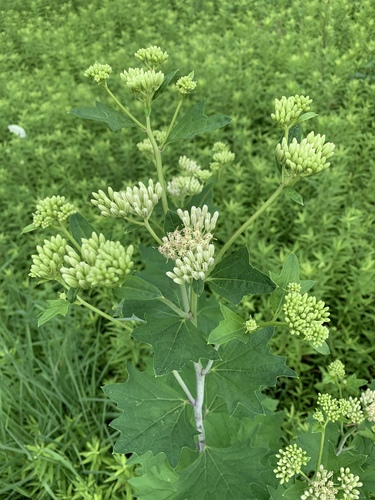
Arnoglossum atriplicifolium (L.) H.Rob. is a large perennial plant. It grows an unbranched stalk up to 2 metres (5 ft) tall, and may sometimes grow much taller, which rises from a basal rosette up to 0.3 metres (1 ft) wide. The stalk is pale green to pale purple, and bears alternate leaves that measure up to 20 centimetres (8 in) long and 20 centimetres (8 in) across; leaves become smaller as they ascend the stalk. The stems and lower surface of the leaves are grayish white. This coloring gives the species its common name "pale" Indian plantain, and acts as a distinguishing feature when separating Arnoglossum atriplicifolium from other species in the Arnoglossum genus. At the top of the central stalk grows a flat-topped corymb, or cluster, holding 4 to 15 flower heads. Flower heads are white, sometimes with small patches of green or purple, and contain only disc florets with no ray florets. This plant spreads via underground rhizomes. It is widely distributed across the central and eastern states of the United States, ranging from the Atlantic Coast west to Kansas. It is listed as endangered in the state of New Jersey. It grows in pastures, along roadsides, and at the edges of woods. Flowers bloom from July to November. The plant is pollinated by insects, primarily wasps including sand wasps (Bicyrtes), great black wasps (Sphex pensylvanicus), great golden digger wasps (Sphex ichneumoneus), and thread-waisted wasps (Ammophila spp.), alongside flies and small bees. Historically, the Cherokee Indians used leaves from this plant as a poultice for cuts and bruises: the bruised leaf was bound over the affected spot and removed frequently.