About Arnica parryi A.Gray
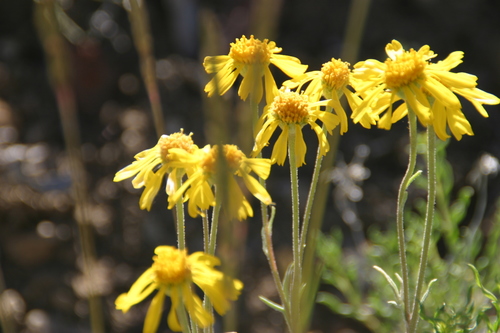
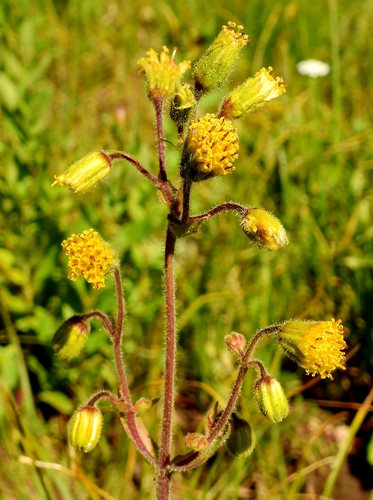
Arnica parryi A.Gray, a North American flowering plant, has two common names: Parry's arnica and nodding arnica. It is native to western Canada, specifically Yukon, British Columbia, and Alberta, as well as the western United States, ranging south as far as Inyo County, California and McKinley County, New Mexico. It grows in mountainous regions, primarily the Rocky Mountains, Cascades, and Sierra Nevada, where it inhabits temperate coniferous forests and alpine meadows. This is a rhizomatous perennial herb that grows one single unbranched stem, reaching heights between 10 and 60 centimeters. Oval-shaped leaves grow around the base of the stem, with a few pairs of longer, narrower leaves with petioles growing above these basal leaves. On larger plants, leaves can reach up to nearly 20 centimeters in length. Petioles, leaves, flower stems, and bracts are covered in short white hairs, with coverage ranging from sparse to dense. These hairs, called trichomes, are sometimes glandular, with a bulbous secretory tip at the end. The inflorescence holds one or more daisylike flower heads. These heads nod while they are still buds, then stand erect once the flower face opens. Each flower head has a center filled with yellow disc florets, and usually does not produce any ray florets. Its fruit is a cylindrical achene roughly half a centimeter long, topped with a bristly tan to brown pappus.