About Arnica cordifolia Hook.
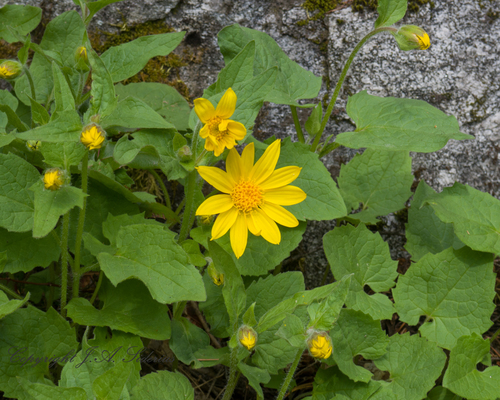
Arnica cordifolia Hook. is a rhizomatous perennial herb. It produces one or more erect stems that grow to a maximum height of around 60 centimeters, or 2 feet. The stem holds two to four pairs of leaves, each borne on a long petiole. The leaves are shaped from heart-shaped to arrowhead-shaped, with fine teeth along their edges. The inflorescence holds one or more daisy-like flower heads that are 5 to 9 centimeters (2 to 3 and a half inches) wide. The flower heads are lined with white-haired phyllaries, and are sometimes dotted with resin glands. The center of each head holds golden yellow disc florets, surrounded by a fringe of 10 to 15 bright golden ray florets that reach a maximum length of 3 centimeters, or 1 and a quarter inches. Flowering typically occurs from April to June, though blooming can occur as late as September in some cases. The fruit is a hairy achene up to 1 centimeter, or half an inch, long, not including its off-white pappus. Seeds are dispersed by wind. An individual plant can live up to 12 years, and survives periodic wildfire by resprouting from its long, slender rhizome after fire occurs. This species can be mistaken for the similar species Arnica latifolia, but the two can be told apart by leaf characteristics: A. cordifolia has larger, heart-shaped leaves. This plant is native to western North America, ranging from Alaska to California to New Mexico, and extending east as far as Ontario and Michigan. It grows in a wide variety of habitat types, including coniferous forests and moist mountain meadows. It occurs from sea level up to altitudes above 3,700 meters (12,000 feet), and is most common between 1,200 and 3,400 meters (4,000 to 11,000 feet). Dried leaves of Arnica cordifolia Hook. can be made into a poultice or tincture used to treat strains and bruises.