About Armillaria solidipes Peck
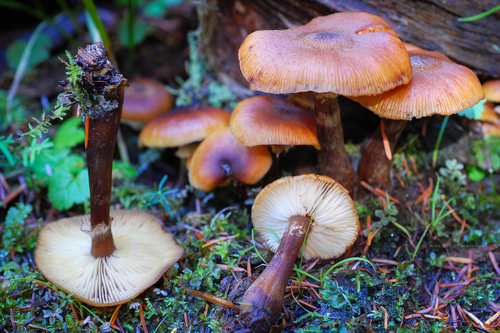
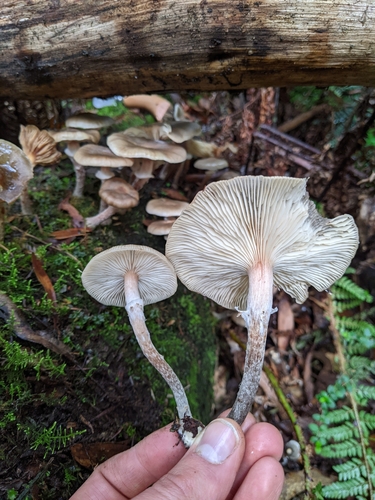
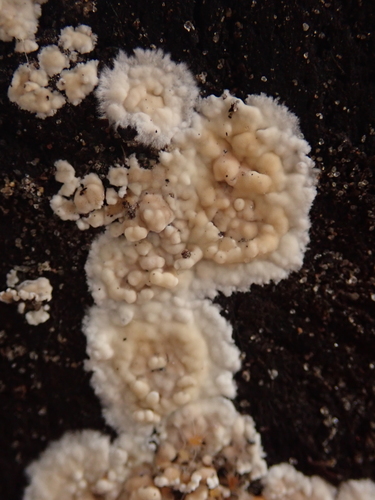
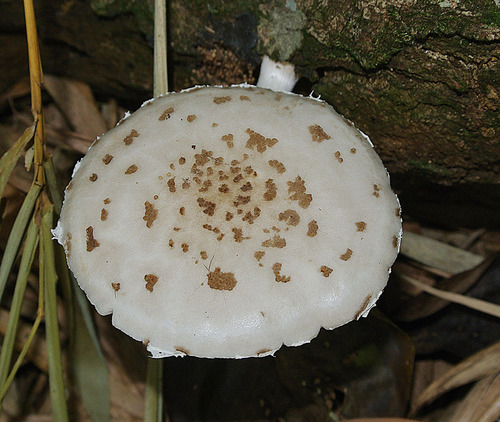
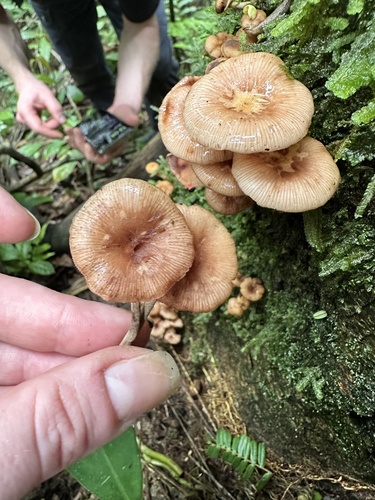
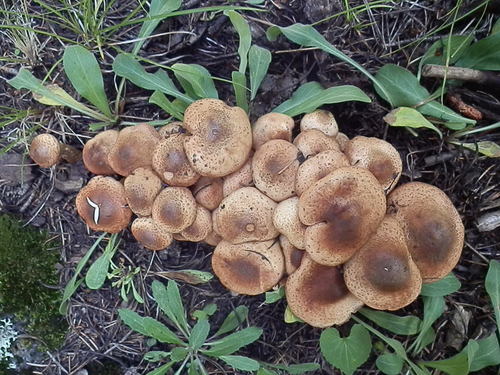
Like most parasitic fungi, Armillaria solidipes Peck (also referenced as Armillaria ostoyae) reproduces sexually. It starts its life cycle as spores released into the environment by a mature mushroom. Spores have two distinct mating types, which function similarly to male and female sexes. Spores are dispersed by environmental factors such as wind, or can be redeposited by animals. After spores enter a resting state, a single spore must come into contact with a spore of the same species and a complementary mating type. If the spore isolates belong to different species, their colonies will not fuse and will remain separate. When two isolates of the same species but different mating types fuse, they quickly form coalesced colonies that become dark brown and flat. This fungus produces shoestring-like mycelial cords called rhizomorphs. Rhizomorphs allow the fungus to access nutrients across distances, and are the main driver of its pathogenicity. As the fruiting body grows and accumulates nutrients, it develops into a mature mushroom. Armillaria ostoyae produces wide, thin gills that radiate decurrently from the stem, leave a white spore print, and the stem has a well-developed ring. Like several other Armillaria species, the mycelium of A. ostoyae can be bioluminescent, producing the phenomenon known as foxfire. Once spore formation is complete, the mature mushroom releases its spores to start a new generation. Armillaria ostoyae is most common in cooler regions of the northern hemisphere. In North America, it grows on host coniferous trees in the forests of British Columbia and the Pacific Northwest of the United States, and also occurs in parts of Asia. It is found across all biogeoclimatic zones of British Columbia, but the root disease it causes is most severe in the interior of the region, in the Interior Cedar Hemlock biogeoclimatic zone. It occurs in both the more common interior sites and along the British Columbia coast. A colony of this fungus in the Malheur National Forest in the Strawberry Mountains of eastern Oregon is the largest known fungal colony in the world, spanning 3.5 square miles (2,200 acres; 9.1 km²). This organism is estimated to be around 8,000 years old and may weigh up to 35,000 tons. If counted as a single organism, it is one of the largest known organisms in the world by area, only rivaled by a colony of Posidonia australis on the Australian seabed that measures 200 square kilometres (77 mi²; 49,000 acres). It also rivals the aspen grove "Pando" as the known organism with the highest living biomass. Another well-known large individual called the "humongous fungus", a specimen of Armillaria gallica found near Crystal Falls, Michigan that covers 91 acres (0.37 km²; 0.142 sq mi), originated from a parent fungus in Ontario. This species is classified as a choice edible mushroom.