About Armillaria nabsnona T.J.Volk & Burds.
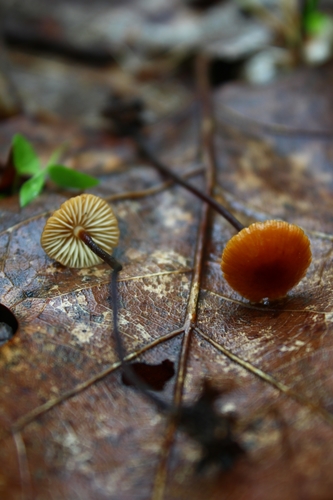
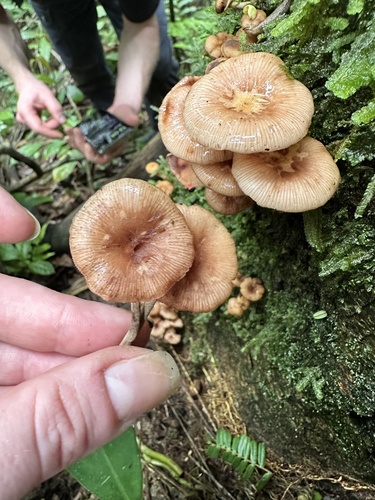
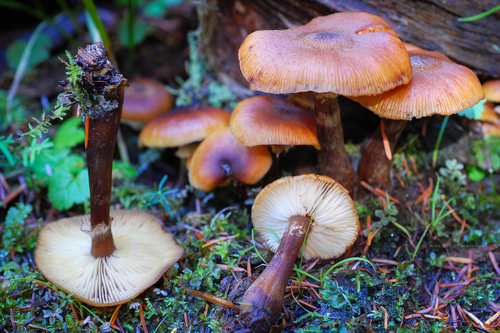
The fruit bodies of Armillaria nabsnona have caps that start convex and flatten with age, reaching 4 to 7 cm (1 5/8 to 2 3/4 inches) in diameter. The cap surface is smooth, becoming sticky when wet, and young specimens may have short, dark hairs at the center. Cap color ranges from reddish to brownish, fading to paler tones toward the edge, and often has darker, irregularly shaped bruise spots. The cap margin looks grooved or furrowed due to its thin flesh, which measures 0.5–1 mm thick, and the gills on the underside of the cap. The gills attach to the stipe in an adnate to somewhat decurrent arrangement. They are somewhat distantly spaced, 0.75–1 mm wide, and are initially white to cream before darkening to pinkish-tan as they mature. The stipe is brownish, darker toward its base, measures 8–10 cm (3 1/8–3 7/8 inches) long by 2–3 mm thick, and has a broader base 4–5 mm wide. It bears a ring, with whitish patches of cottony mycelium on its surface below the ring. The ring forms from a dense, white, cottony partial veil that becomes ragged as the cap grows, and sometimes persists as a temporary cortina. If present, rhizomorphs are black, branched, and 1–2 mm thick. The spore print of this fungus is white. Spores are smooth, hyaline (translucent), inamyloid, and have an ovoid to roughly spherical shape, typically measuring 8–10 by 5.5–6.5 micrometers. The basidia are club-shaped, four-spored, and measure 25–35 by 5.5–6 micrometers, with a clamp connection at their bases. Additional basidia can grow from this basal clamp, a branching pattern that sets this species apart from other Armillaria. This feature becomes less visible as the hymenium matures, when neighboring basidia expand and grow crowded together. The mycelium of Armillaria nabsnona is bioluminescent. Fruit bodies of Armillaria nabsnona grow in groups, but do not form clustered clusters connected at the base. They grow on hardwood trees, especially Alnus, located in riparian areas. While it most commonly produces fruit bodies in autumn, it has been recorded fruiting in spring in Oregon. The species was originally described with a range covering roughly the Pacific Northwest region of North America, including the U.S. states of Washington, Oregon, California, Idaho, Alaska, and the Canadian province of British Columbia. It was recorded in Hawaii in 2008, and reported from Hokkaido Island in northern Japan in 2009. Japanese researchers have documented a symbiotic association between Armillaria nabsnona and the orchid Gastrodia elata.