About Armillaria luteobubalina Watling & Kile
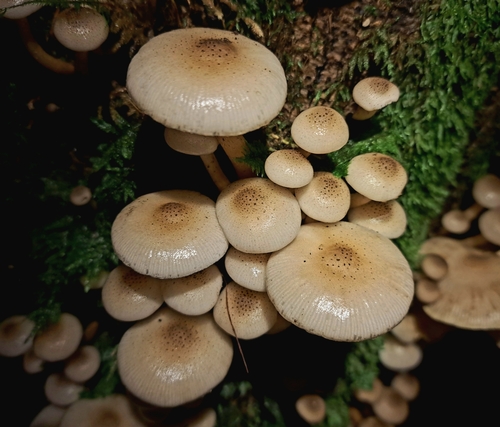
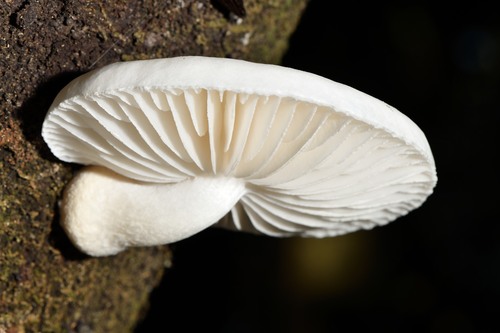
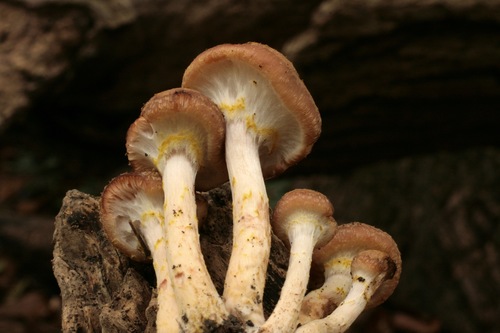
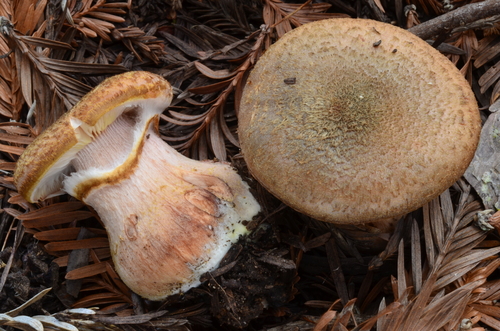
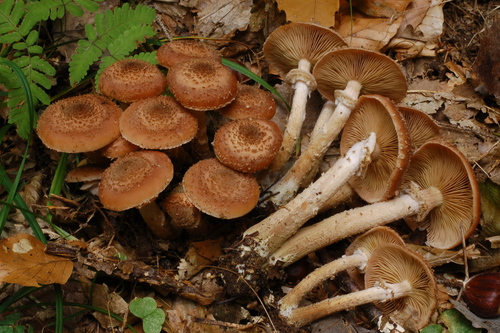
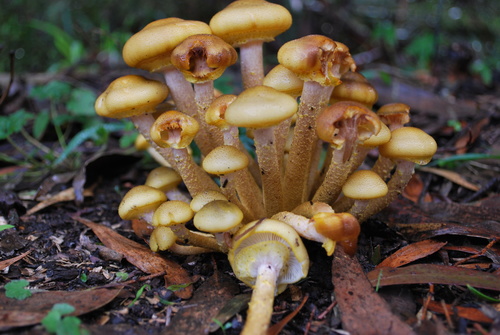
This species, Armillaria luteobubalina Watling & Kile, has a cap that reaches up to 10 cm (4 in) in diameter. The cap ranges from convex to flattened in shape, with a central rounded elevation called an umbo, and comes in various shades of cream, yellow, and tan. Its surface is covered in darker scales and has a rough texture; the cap margin (edge) is rolled inward in young specimens. The gills are crowded, sinuate, and start off white to cream in color, becoming brownish-cream or pinkish brown when mature, and sometimes develop yellow or rust-colored marks near their margins. The stem is centrally attached to the cap, grows up to 20 cm (8 in) long by 1.5 cm (1 in) thick, and is slightly wider at its base than at its apex, sometimes appearing almost bulbous. The stem surface has lengthwise streaks of fibrils, and bears a floppy, yellow, wool-like ring that may develop irregular, jagged edges over time. The mushroom's flesh is white; the flesh of the stem has a woolly or stringy texture. For microscopic characteristics, fresh spore prints of this species are white, and turn more cream-colored when dry. Spores are smooth, oval to ellipsoid, translucent (hyaline), non-amyloid (do not absorb iodine from Melzer's reagent), and typically measure 6.5–7.5 by 4.5–5.5 μm. Basidia (the spore-bearing cells) are thin-walled, hyaline, and do not have clamp connections at their bases. They are usually four-spored, though occasionally two-spored, with spore-attaching projections called sterigmata up to 4 μm long. Cheilocystidia (cystidia found on gill edges) are mostly club-shaped, thin-walled, hyaline, and measure 15–30 by 6–10 μm. Armillaria luteobubalina has been recorded in Australia: it occurs in southeastern Australia, from the southeastern corner of Queensland through eastern New South Wales and across Victoria into southeastern South Australia, and also grows in Tasmania and southwestern Western Australia. Mushrooms from karri forests (dominated by Eucalyptus diversicolor) in southwestern Western Australia have paler, yellower caps than mushrooms from jarrah forests (dominated by Eucalyptus marginata) further north. Fruit bodies grow on wood, especially on stumps or around the base of trees, and often appear in very large numbers. They usually fruit between April and July, with the heaviest fruiting occurring in the second half of May. Abundant in Australian woodlands, this species can invade gardens and orchards and attack many woody plants. It infected and killed many plants near cut-down tuart trees (Eucalyptus gomphocephala) near Kings Park in suburban Perth. Armillaria luteobubalina is common in Australian eucalyptus forests, and is thought to be the most pathogenic and most widespread Armillaria species in the major forest types of western Australia. The mushroom has also been reported from southern South America, in Argentina and Chile. A 2003 study of the molecular phylogenetics and distribution pattern of A. luteobubalina in South America and Australia concluded that this is an ancient species that originated before the split of the supercontinent Gondwana. Genetic differences between isolates from South American and Australian populations show a long period of geographical separation, and the study authors note these populations might later be recognized as separate independent taxa. Although this species has a hot-bitter taste, it is edible, and cooking removes its bitterness.