About Armillaria gallica Marxm. & Romagn.
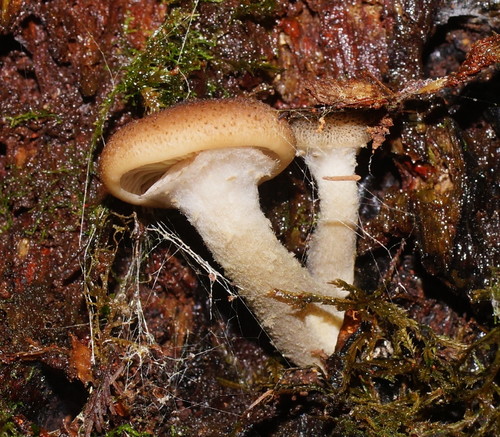
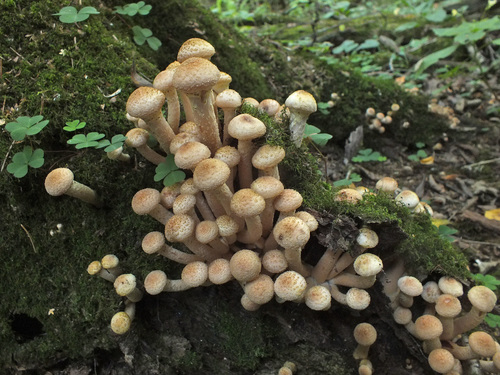
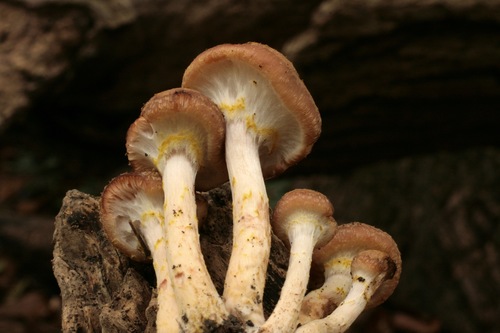
The fruit bodies of Armillaria gallica have caps 2.5–9.5 cm (1.0–3.7 in) broad. Caps range in shape from conical to convex to flattened depending on age. When moist, caps are brownish-yellow to brown, often with a darker center, and their color fades as they dry. The cap surface is covered with slender, cap-colored fibers that are either erect or sloping upwards. Young fruit bodies have a cottony partial veil (a layer of tissue stretching from the cap edge to the stem) on the underside of the cap that protects developing gills. As the cap grows, this membrane pulls away to expose the gills. Gills attach to the stem in an adnate (squarely attached) to somewhat decurrent (extending down the stem) arrangement. They start white, and age to a creamy or pale orange color covered with rust-colored spots. The stem is 4–10 cm (1.6–3.9 in) long and 0.6–1.8 cm (0.24–0.71 in) thick, and is nearly club-shaped, with a base 1.3–2.7 cm (0.5–1.1 in) thick. Above the ring, the stem is pale orange to brown; below the ring it is whitish or pale pink, turning grayish-brown at the base. The ring sits 0.4–0.9 cm (0.16–0.35 in) below the cap, and may be covered with yellowish to pale-brownish woolly cottony mycelia. The stem base attaches to rhizomorphs, which are black root-like structures 1–3 mm in diameter. Below-ground mycelia primarily function to absorb nutrients from soil, while rhizomorphs act to explore for new food bases.
Armillaria gallica normally grows on the ground, and sometimes on stumps and logs; apparently terrestrial mushrooms are attached to plant roots below the surface. It is widely distributed, and has been collected in North America, Europe, and Asia (including China, Iran, and Japan). It has also been found in South Africa's Western Cape Province, where it is thought to have been introduced via potted plants imported from Europe during the early colonization of Cape Town. In Scandinavia, it is absent from very cold climate areas such as Finland and Norway, but is present in southern Sweden. It is thought to be the most common low-altitude Armillaria species in Great Britain and France. Its upper altitude limit varies by region: it occurs up to 1,100 m (3,600 ft) in the French Massif Central, up to 600 m (2,000 ft) in Bavaria (which has a more continental climate), and it is the most common Armillaria in Serbian forests between 70 m and 1,450 m (230 ft to 4,760 ft) elevation. Field studies indicate A. gallica prefers sites with low organic matter content and high soil pH. In North America, it is common east of the Rocky Mountains but rare in the Pacific Northwest. In California, where it is widely distributed, it grows in a variety of plant communities, including aspen, coastal oak woodland, Douglas Fir, Klamath mixed conifer, montane hardwood, montane hardwood-conifer, montane riparian, Redwood, Sierran mixed conifer, valley oak woodland, valley-foothill riparian, and White Fir. It was found to be the most common Armillaria species in hardwood and mixed oak forests in western Massachusetts. A 2001 Chinese study used the molecular biological technique restriction fragment length polymorphism to analyze DNA sequence differences between 23 A. gallica specimens collected from the Northern Hemisphere. Results suggest that based on observed restriction fragment length polymorphism patterns, there are four global A. gallica subpopulations: the Chinese, European, North American–Chinese, and North American–European geographical lineages. A 2007 study of Armillaria distribution in northeastern and southwestern China, which used fruit body and pure culture morphology, concluded that several unnamed species (Chinese biological species C, F, H, J and L) are similar to common A. gallica.
The life cycle of A. gallica includes two diploidization–haploidization events. The first is the standard process of cell fusion (forming a diploid) followed by meiosis during the formation of haploid basidiospores. The second event is more cryptic and occurs before fruit body formation. In most basidiomycetous fungi, hyphae of compatible mating types fuse to form a two-nucleate, dikaryotic stage. Armillaria species do not have this stage, as their cells are mostly monokaryotic and diploid. Genetic analyses suggest that dikaryotic mycelia undergo an extra haploidization event before fruit body formation to create a genetic mosaic. These regular, repeating haploidization events increase genetic diversity, which helps the fungus adapt to unfavorable environmental changes like drought. The growth rate of A. gallica rhizomorphs is between 0.3 and 0.6 m (1.0 and 2.0 ft) per year. Population genetic studies of the fungus conducted in the 1990s showed that genetic individuals grow mitotically from a single point of origin to eventually occupy territories that can include many adjacent root systems across large areas (several hectares) of forest floor. Based on low mutation rates observed in large, long-lived individuals, A. gallica appears to have an unusually stable genome. It has also been hypothesized that genetic stability may come from self-renewing mycelial repositories of nuclei with stem cell-like properties. Specific mechanisms of somatic growth have been proposed to explain how species such as A. gallica control somatic mutations, supporting their longevity. The common feature of these mechanisms is asymmetric cell division, in which a group of slowly dividing cells is maintained, so these cells are less prone to replication errors that cause mutations. It has been proposed that the mutation rate at A. gallica's somatic growth front is kept low because cells at the front divide infrequently, while producing rapidly dividing cells behind the growth front that promote tissue growth, even though this carries a higher mutation rate.
Armillaria gallica is a weaker pathogen than related species A. mellea or A. solidipes, and is classified as a secondary parasite, typically only initiating infection after a host's defenses have been weakened by insect defoliation, drought, or infection by another fungus. Infection by this fungus can cause root rot or butt rot. As diseased trees die, their wood dries out, increasing the chance of fire after a lightning strike; the resulting forest fire may in turn kill the species that killed the trees. Plants under water stress caused by dry soils or waterlogging are more susceptible to A. gallica infection. It is one of several Armillaria species responsible for widespread oak tree mortality in the Arkansas Ozarks. The fungus has also been recorded infecting Daylily in South Carolina, Northern highbush blueberry (Vaccinium corymbosum) in Italy, and vineyards (Vitis species) of Rías Baixas in northwestern Spain; the latter infestation may be related to the fact that the sampled vineyards were located on cleared forestry sites. When A. solidipes and A. gallica grow in the same forest, root system infection by A. gallica may reduce damage or prevent infection by A. solidipes.
Armillaria gallica can develop an extensive subterranean system of rhizomorphs, which helps it compete with other fungi for resources and attack trees weakened by other fungi. A field study in an ancient broadleaved woodland in England found that of five Armillaria species present in the woods, A. gallica was consistently the first to colonize tree stumps that had been coppiced the previous year. Fractal geometry has been used to model hyphal branching patterns of various Armillaria species. Compared to strongly pathogenic species like A. solidipes, A. gallica has a relatively sparse branching pattern thought to be consistent with a foraging strategy where acceptable food bases may be encountered at any distance, which favors a broad and divisive distribution of potential inoculum. Because the rhizomorphs form regular networks, mathematical graph theory concepts have been used to describe fungal growth and interpret ecological strategies, indicating that specific network attachment patterns allow the fungus to respond opportunistically to spatially and temporally changing environments.
Armillaria gallica can itself be parasitized by other soil flora. Several species of the fungus Trichoderma, including Trichoderma polysporum, T. harzianum and T. viride, can attack and penetrate the outer tissue of A. gallica rhizomorphs and parasitize the internal hyphae. Infected rhizomorphs become completely empty of living hyphae about one week after the initial infection. Entoloma abortivum is another fungus that can live parasitically on A. gallica. The resulting whitish-gray malformed fruit bodies occur when E. abortivum hyphae penetrate the A. gallica mushroom and disrupt its normal development.