About Aristaloe aristata (Haw.) Boatwr. & J.C.Manning
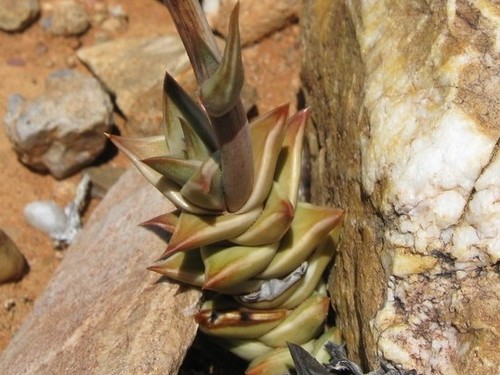
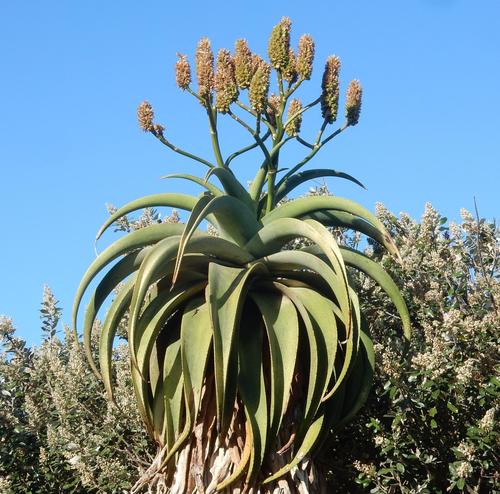
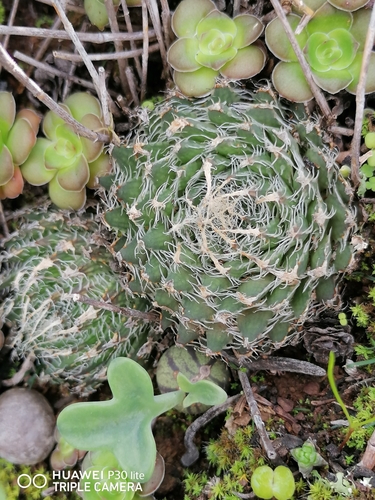
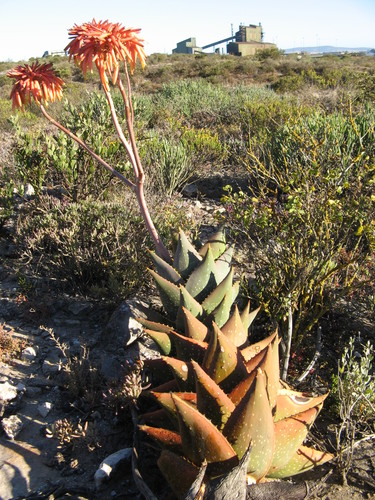
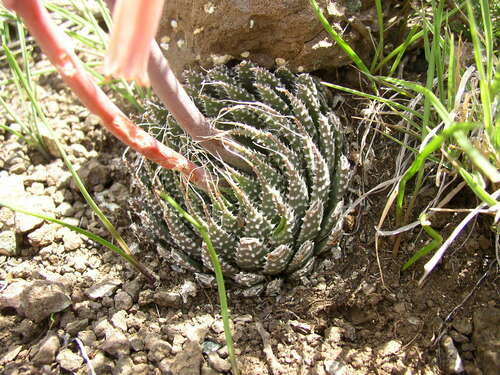
This species is a stemless, sawtoothed succulent. Its soft succulent leaves grow in dense, imbricate rosettes. The leaves are lanceolate, have bristly margins, and end in a long thread-like tip (an aristate tip). The plant produces nectar-rich, tubular orange flowers that readily attract birds, bees, and wasps. When not in bloom, it resembles and is often confused with other species such as Haworthiopsis fasciata.
This species is indigenous to South Africa and Lesotho. Its natural native range stretches from the Karoo region of South Africa's Northern Cape and Eastern Cape Provinces, eastward through the Free State and Lesotho, reaching as far as the borders of KwaZulu-Natal Province. Over this wide range, this adaptable species grows in many different habitats, from the dry, sandy Nama Karoo, to the high grasslands and cold mountain slopes of Lesotho, to the shady forested valleys of KwaZulu-Natal.
It is commonly cultivated as a garden plant worldwide. It prefers well-drained soils, but can tolerate a wide range of rainfall conditions. Thanks to its adaptation to cold mountain tops, it can withstand temperatures as low as −7 °C. In extremely cold temperate regions, it usually needs to be grown indoors or under glass to provide winter warmth. This clumping species easily produces large numbers of offsets, which can be separated and planted to propagate the plant. It has been awarded the Royal Horticultural Society's Award of Garden Merit.