About Arisarum simorrhinum Durieu
Arisarum simorrhinum Durieu is a perennial tuberous plant that lacks true stems; all its leaves arise directly from its underground tuber. The plant typically reaches 15 to 40 centimetres (5.9 to 15.7 in) in height, with a maximum height of 30 centimetres (12 in).
Its underground structures are a tuber measuring 1–4.5 by 0.6–3.5 centimetres, rhizomes that grow up to 9 by 1.5 centimetres, and roots that reach up to 9 centimetres (3.5 in) in length. Leaves are shaped cordate to hastate-sagittate, borne on long, winged petioles that measure 5–34 by 0.1–0.9 centimetres; petioles sometimes bear small purple spots. The leaf blade (lamina) measures 5–12 by 3.5–10 centimetres, with a cordate to hastate base and acute to rounded lobes that are 0.5–5.9 by 0.5–4 centimetres.
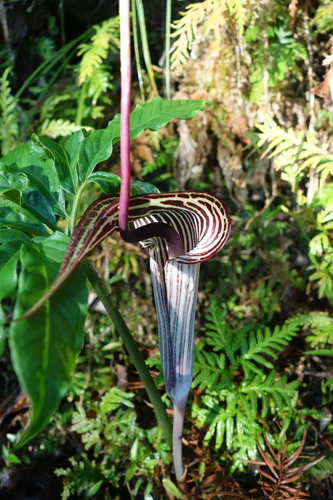
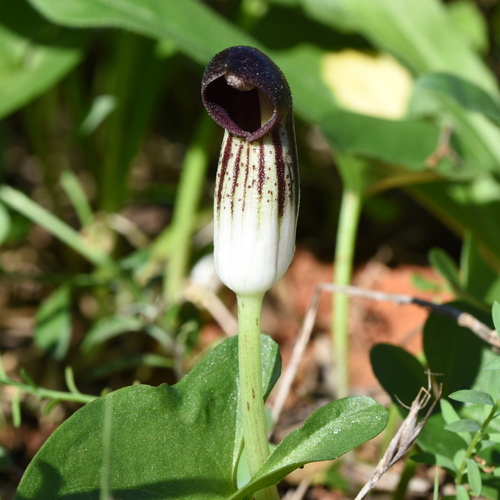
The inflorescence of this species is usually shorter than the leaves, and grows on a purple-stained peduncle that measures 4–22.6 by 0.1–0.6 centimetres, which is generally flexible and thin. The entire inflorescence measures 0.7–2 by 1–2.4 centimetres. The small flowers are carried on a rod-like spadix, which is enclosed by a specialized bract called the spathe. The spathe is upright, with its lower margins joined to form a closed tube 2–6 centimetres (0.79–2.36 in) long; the tube is 1.5–3 centimetres wide at the bottom, marked with purple spots, and curves upward into a forward-tilting helmet-shaped upper portion. The spathe margin is smooth or papillary, has a longitudinal nerve, and is purple at the apex, fading to a paler, less pigmented colour towards the base. The spadix is held inside the spathe, and has a sterile terminal section that is arched in its upper half and unequal to the lower section of the spadix.
Fruits of Arisarum simorrhinum consist of 2 to 8 greenish, not very fleshy berries. Each berry measures 5–15 by 5–14 millimetres (0.20–0.59 in by 0.20–0.55 in) and contains 1 to 12 seeds.
Arisarum simorrhinum is native to most of Portugal, western Spain, Morocco, and northwestern Algeria. It is a nitrophilic species that grows on both acidic and basic soils, most often on disturbed ground. It can be found in sandy soils in pastures, clearings within scrub and woodland, along roadsides and ditch margins, on cultivated land, and among rocky outcrops. It grows at altitudes ranging from sea level up to 840 metres (2,760 ft). Published records from the Canary Islands, Balearic Islands, Madeira, and Tunisia are erroneous, resulting from taxonomic confusion with Arisarum vulgare subsp. subexsertum.