About Arisaema triphyllum (L.) Schott
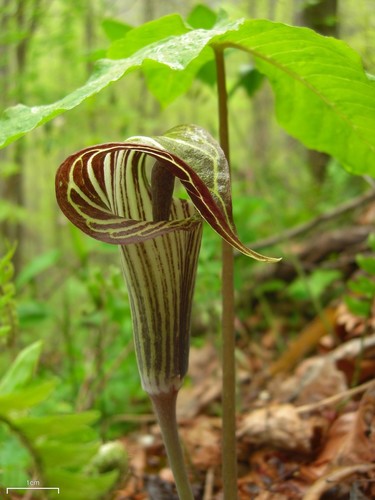
The Arisaema triphyllum complex includes four closely related species: Arisaema pusillum, Arisaema stewardsonii, Arisaema quinatum, and Arisaema triphyllum sensu stricto. A fifth species, Arisaema acuminatum, is sometimes included in this complex, but its status as a valid species is controversial. Arisaema triphyllum sensu lato is a herbaceous perennial flowering plant that grows from a corm. It typically reaches up to 2 feet (61 cm) tall, but populations in Georgia and Florida are known to grow to almost twice that maximum height. Most plants have 1 or 2 leaves, each bearing three leaflets, which is the source of the epithet "triphyllum". Occasionally, the lateral leaflets will be two-parted or lobed, creating the appearance of five leaflets per leaf. One species in the complex, A. quinatum, typically has five such pseudo-leaflets per leaf. The small, inconspicuous flowers of Jack-in-the-pulpit, the common name for this species complex, are borne on a fleshy, spike-like inflorescence called a spadix, also known as "Jack". The spadix is enclosed or nearly enclosed by a large, sometimes colorful bract called a spathe, also known as "pulpit". Flowers are clustered around the base of the spadix, inside the spathe. A sterile spadix appendix protrudes from the opening of the spathe tube. This appendix is covered by the leafy tip of the spathe, called the spathe hood (or spathe lamina). The lip along the opening of the spathe tube, which acts as a landing platform for winged insects, is called the spathe flange. The inflorescence can be male (bearing only male flowers), bisexual (bearing both male and female flowers), or female (bearing only female flowers). Arisaema triphyllum is unusual because individual plants change sex in a pattern determined by their size. Small plants produce mostly or entirely male flowers. As the plant matures and grows larger, the spadix begins to produce both male and female flowers. The transition from male to female continues until the mature plant eventually produces only female flowers. This pattern is an example of dichogamy, a rare phenomenon in flowering plants. Due to this sex-changing lifecycle, the species is sometimes colloquially called Jack or Jill in the pulpit, or Jill-in-the-pulpit. Unripe fruits are smooth, shiny green berries each 1 cm wide, clustered around the thickened spadix. Fruits ripen in late summer and early fall, turning a bright, conspicuous red. Each berry usually produces 1 to 5 seeds, which are white to light tan, rounded, often with flattened edges and a short sharp point at the top. If seeds are removed from the berry, they will germinate the following spring, producing seedlings that each have a single rounded leaf. A seedling requires three or more years of growth before it is mature enough to flower. Arisaema pusillum, Arisaema stewardsonii, and Arisaema quinatum are diploid, with 28 chromosomes. Arisaema triphyllum s.s. is predominantly tetraploid, with 56 chromosomes, but plants otherwise indistinguishable from typical A. triphyllum occasionally have 28 chromosomes. Two such 28-chromosome plants were found in Cayuga County, New York in the 1940s. The evolutionary origin of the tetraploid form is unknown. A set of key characteristics is used to separate members of the Arisaema triphyllum complex. To identify an individual to species, the following questions are asked in order: Is it Arisaema stewardsonii? (Does it have a strongly fluted spathe tube?) If not, continue. Is it Arisaema quinatum? (Does it have a curved spadix appendix?) If not, continue. Is it Arisaema pusillum? (Check for multiple matching characters.) If none of these match, it is classified as Arisaema triphyllum s.s. While the taxa are morphologically distinct, identification can be difficult, especially for herbarium specimens, where the required identifying characteristics are often lost during pressing and drying. Non-flowering plants are sometimes confused with Pinellia, a genus native to East Asia that has been introduced to a small number of eastern U.S. states, including the District of Columbia, Maryland, New York, Pennsylvania, and West Virginia. Arisaema triphyllum sensu lato has a wide distribution across eastern North America, ranging from Nova Scotia in the northeast to Florida in the southeast. Its range stretches west across the Mississippi River valley into the Great Plains, reaching from Texas in the southwest to Manitoba in the northwest. It is common throughout most of its range, occurring in most counties across over 30 eastern U.S. states. Less is known about the distribution of Arisaema triphyllum sensu stricto. Based on records of Arisaema triphyllum subsp. triphyllum, it can be inferred that Arisaema triphyllum s.s. is also wide-ranging, with known occurrences across 6 Canadian provinces and 37 U.S. states plus the District of Columbia. In the southeastern United States, it is common as far south as the Florida panhandle. A. triphyllum grows in mesic, shaded forests. Arisaema triphyllum sensu lato flowers from April to June. Arisaema triphyllum sensu stricto is the first to flower in spring. In regions where the species overlap in range (sympatric regions), Arisaema stewardsonii begins flowering 1 to 2 weeks after A. triphyllum s.s., and Arisaema pusillum begins flowering 2 to 3 weeks after A. triphyllum s.s. Since an individual plant's flowering period can last 1 to 3 weeks or more, all three species can often be found in flower at the same time. In the southeastern United States, Arisaema quinatum is reported to flower later than both A. pusillum and A. triphyllum s.s. Arisaema triphyllum sensu lato is pollinated by fungus gnats. The plant attracts fungus gnats with scent and traps them inside the flower. Gnats can escape through a hole at the bottom of a male spathe, but they cannot escape when they enter a female spathe, which lacks an exit hole. This makes female Jack-in-the-pulpit a rare "femme fatale": it lures gnats in with scent, and ultimately kills the pollinators in a death trap. Other insects, including gall gnats and beetles, are also known to visit the flowers. This plant cannot self-pollinate, because the male flowers on an individual plant mature and die before that same plant's female flowers mature. So female flowers must be pollinated by male flowers from a different plant. This prevents inbreeding and supports overall species health. Arisaema pusillum, Arisaema stewardsonii, and Arisaema triphyllum sensu stricto are reproductively isolated in the wild, with some degree of ecological separation. However, an intermediate population between Arisaema stewardsonii and Arisaema triphyllum s.s. is known to occur near Clyde, New York. Individuals from this population have glaucous leaves (like A. triphyllum) and strongly fluted spathes (like A. stewardsonii), and grow in dry sandy soil (a habitat matching neither parent species). Chromosome counts were performed on six of these plants. Four were found to be diploid with 28 chromosomes (like A. stewardsonii), while two were triploid with 42 chromosomes (an intermediate count). All parts of Jack-in-the-pulpit contain oxalic acid and calcium oxalate crystals called raphides, making it poisonous if ingested. Consumption of raw plant material causes an intense burning sensation, irritation of the mouth and digestive system, and in rare cases severe swelling of the mouth and throat that can be severe enough to affect breathing. Arisaemas belong to the same plant family as anthuriums, aglaonemas, alocasias, colocasias, dieffenbachias, monsteras, philodendrons, and many others collectively known as "dumb-canes", all of which cause inflammation of the upper respiratory and digestive system when ingested. If properly cooked, the plant can be eaten as a root vegetable. The calcium oxalate crystals create a peppery flavor. If the plant is sliced and dried, it can be eaten like potato chips or ground into flour. A preparation made from the root was reported to have been used by Native Americans to treat sore eyes. Preparations were also used to treat rheumatism, bronchitis, and snakebites, as well as to induce sterility. One account from the Meskwaki people states that they would chop the plant's corm, mix it with meat, and leave the meat out for enemies to find. The oxalate taste would be undetectable due to the flavored meat, but consumption would reportedly cause pain and death for the enemies. The Meskwaki also reportedly used the plant to determine the fate of sick people: a seed was dropped into a cup of stirred water. If the seed went around four times clockwise, the patient would recover; if it went around fewer than four times, the patient would not recover. The plant is hardy to USDA plant hardiness zone 3.