About Arisaema heterophyllum Blume
Root Morphology
Arisaema heterophyllum Blume has depressed globose, tubular roots with a diameter of approximately 2–6 cm.
Leaf Arrangement and Petiole
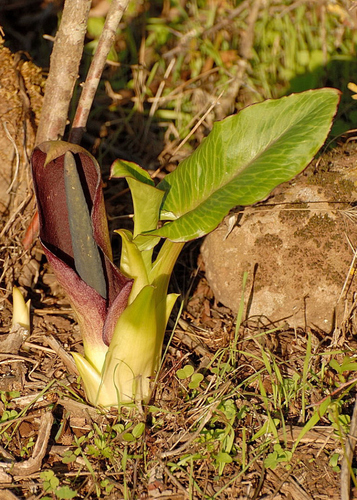
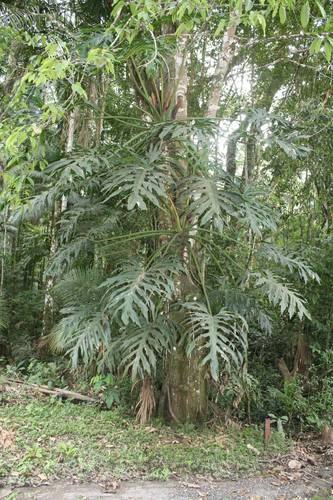
Its leaves are usually solitary, around 30–60 cm long, with glaucous petioles that sheath near the pseudostem.
Leaf Surface Coloration
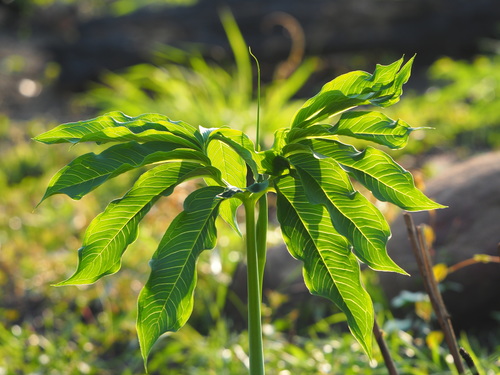
Leaves are divided gently; they are dull green on the upper (adaxial) surface and pale green on the lower (abaxial) surface.
Cataphyll and Leaflet Count
Each plant has 4 or 5 cataphylls and 11 to 21 leaflets total.
Leaflet Size Variation
The central leaflet measures 3–15 cm long and 0.7–5.8 cm wide, while outermost leaflets are smaller.
Leaflet Spacing
The gap between adjacent leaflets is about 0.5–5 cm.
Leaflet Shape
Leaflets come in a range of shapes including oblanceolate, oblong, and linear-oblong, with both cuneate base and cuneate apex.
Flower Peduncle
The flower peduncle is 50–80 cm long, usually longer than the petiole.
Spathe Tube Morphology
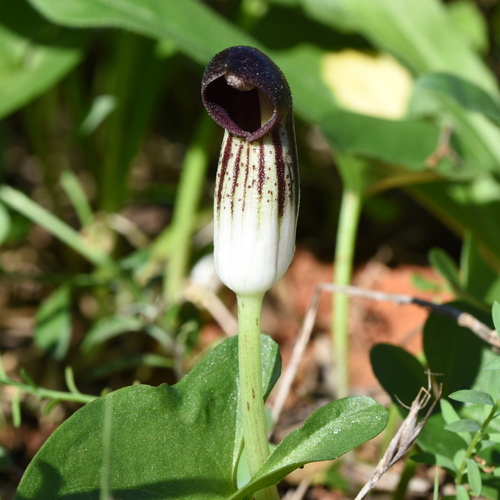
The flower’s spathe tube is cylindrical, 3.2–8 cm long and 1–2.5 cm wide; it is glaucous on the outside and whitish green on the inside, with a slightly recurved throat.
Spadix Sexuality
The flower spadix is either bisexual, or monoecious and male.
Bisexual Spadix Structure
On bisexual spadices, the female section has a punctate stigma, a clear distinct style, and a globose ovary holding 3 to 4 ovules, while the male section holds sterile flowers.
Male Spadix Structure
On male spadices, anther thecae dehisce through apical slits.
Spadix Appendix
The pale white, sigmoid appendix is up to 20 cm long, ascending, and tapers gradually from a sessile base to a sharp apex.
Flowering and Fruiting Period
Flowering typically begins in April or May, and fruiting occurs from July to September.
Fruit Characteristics
Fruits are cylindrical yellowish-red or red berries, usually containing one seed.
Native Range
Arisaema heterophyllum is native to East Asia, including China, Inner Mongolia, Japan, and Korea.
Distribution in China
In China, it occurs across most provinces except the Northwest region and Tibet.
Distribution in Japan
In Japan, it is found in Honshu and Kyushu.
Habitat Types
This species grows in shaded, moist locations including evergreen and deciduous riparian forests, shrublands, inland wetlands, and grasslands.
Soil and Site Preferences
It is closely associated with floodplains and prefers humus-rich, well-draining soil.
Tuber Temperature Tolerance
Its tubers cannot tolerate low temperatures.
Conservation Status in Japan
In Japan, it is classified as a threatened species due to the loss of riparian forest along the major rivers of the Kanto Plain.
Medicinal Use
Many species in the genus Arisaema are used for medicinal purposes in Chinese traditional medicine.