About Ariocarpus fissuratus (Engelm.) K.Schum.
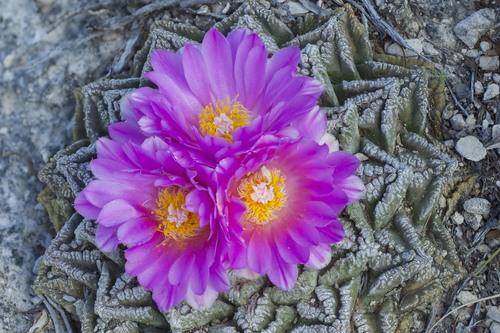
Ariocarpus fissuratus (Engelm.) K.Schum. is a cactus with flattened to spherical bodies ranging 1.5 to 10 cm in height, and up to 10 cm in diameter, rarely reaching 15 cm across. Its body is made up of many small tubercles that grow from a large succulent tap root. Plants are usually solitary, almost always unbranched, and only rarely produce side shoots from old areoles. The cactus is greyish-green in color; flat forms especially develop a yellowish to brownish tint as they age. It has an extremely slow growth rate. The spirally arranged tubercles (warts) are flattened, triangular to rhombic, and sometimes overlap. The hard, horny upper surface of each wart is almost entirely split, and marked with a prominent transverse furrow that connects the areole and axilla. Wool grows from these furrows: it starts as straw-blond, darkens over time, and eventually turns gray. This wool protects the top of the plant, and usually hides its surface from view. Sooner in wild conditions, or later when grown in cultivation, this wool is shed, leaving the furrows of older warts almost bare. This cactus does not produce thorns. Ariocarpus fissuratus has natural camouflage that matches its habitat, making it hard to spot. Individuals are most often located by their pinkish flowers, which bloom in October and early November. Flowers develop singly from the furrows of the youngest areoles, so they sit almost centrally on the cactus body. They range from light purple to pinkish red with a darker central throat, and grow 2.5 to 4.5 cm in diameter. The pollen is orange, and the five to ten tiny, pinnately branched stigmas that sit above the stamens are almost white. After fertilization, spindle- to club-shaped fruits form, which are greenish to white, 5 to 15 mm long and 2 to 6 mm in diameter. Fruits dry out when ripe, and release dull black seeds into the crown wool. In natural conditions, seeds are only washed out of the wool after a long period of time. Especially flattened, yellowish wild plants are very hard to recognize as vegetation, thanks to their semi-subterranean growth habit and jagged tubercles that provide effective mimesis. The chromosome count for this species is 2n=22. Ariocarpus fissuratus is widely distributed in southwest Texas, from southeastern Hudspeth County to the Pecos River, and in the Mexican states of Coahuila, Chihuahua, Durango, Nuevo León, Tamaulipas, and Zacatecas. It grows at elevations between roughly 500 and 1,170 meters, found on dry limestone plains, ridges, and low rocky hills made of limestone chips. In cultivation, Ariocarpus fissuratus is often grafted onto a faster-growing columnar cactus to speed up its growth, because plants generally take at least ten years to reach maturity when growing on their own roots. Cultivated plants need very little water and fertilizer, a good amount of light, and loose sandy soil with good drainage.