About Aricia agestis (Denis & Schiffermüller), 1775
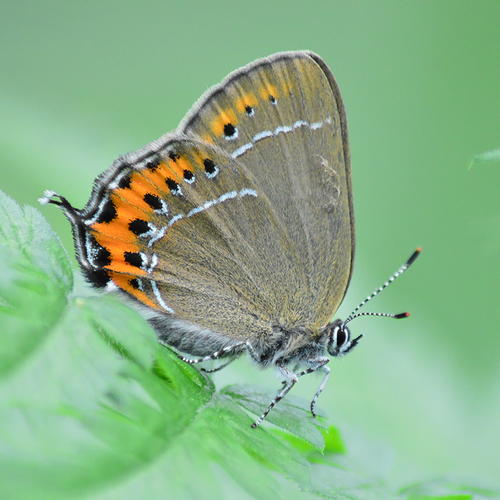
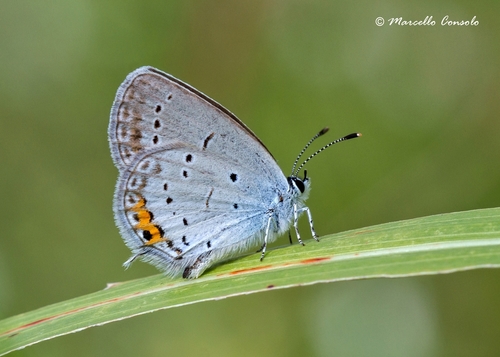
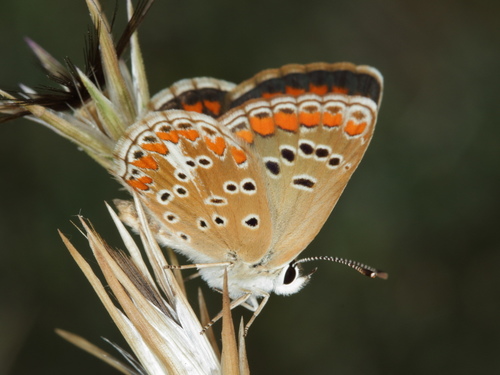
This species is listed under the scientific name Aricia agestis (Denis & Schiffermüller), 1775, and was previously referred to as L. astrarche Bgstr. in Seitz, with synonyms including medon Hufn., agestis Schiff., idas Gerh. (?), and nazira Moore. Above, its wings are similar to the preceding species L. anteros, colored deep dark brown, with a strongly marked discocellular spot that is more prominent in males. In typical specimens, this spot is black, and red spots are present along the outer margin. The underside of the wings has numerous ocelli; on the hindwing, a pale smear runs from the apex of the cell to the center of the outer margin. The species ranges from Scandinavia to the Sahara and northern India, and from the Canary Isles to Askold Island in the Pacific, and can be found at elevations up to 10,000 feet in mountains, according to Doherty. In addition to accidental aberrations that follow the species’ usual patterns of variation, a number of seasonal and geographical forms have been documented. If the spring brood of the Central European form is considered the name-typical astrarche, ab. aestiva Stgr. is the name given to the second brood. This second brood occurs regularly in the southern part of the range and more rarely in the north, and it links astrarche with calida Bell (A. a. calida (Bellier, 1862)). A. a. calida has a much darker underside, nearly coffee-brown, with a broader band of red spots. The egg is pale green, flattened, with a concave top and a finely reticulated surface, as recorded by Tutt, Harrison, and Gillmer. The larva is light green, with a purple dorsal stripe and a similar purple stripe along the sides, with oblique pale smears between the two stripes. Larvae are active in spring and summer, and are present year-round in southern areas, feeding on a variety of plants including Helianthemum, Centaurea, and Erodium. The pupa is pale yellowish green, sometimes with a brown dorsal stripe, and develops on or near the ground. Adult butterflies are on the wing in May, and again from July onward; in southern regions they are active through the entire summer until autumn, with multiple broods per year. They can be found flying in fields, along field paths, on rocky hills, and even in gardens, always flying close to the ground, and are among the most common butterflies. During active flight hours, they rest with their wings spread on grass blades, flowers, or clods of earth; when sleeping, they hold their wings closed and typically hide under umbels and grass inflorescences. Note that information on life cycle and food plants provided here applies specifically to populations of this species in Great Britain, and some details may not match populations in other parts of the species’ range. On calcareous soils, common rock-rose (Helianthemum nummularium) is the preferred food plant. In other habitats, dove's-foot cranesbill (Geranium molle) and common stork's-bill (Erodium cicutarium) are used, and other Geranium species may also be consumed. Eggs are laid singly on the undersides of leaves. The typical slug-like lycid larvae are green, with a pale line along each side, and are always attended by ants. They hibernate when fully grown, and pupate the following spring. Southern colonies have two broods per year, with adults active in May and June, and again from late July to mid-September. Further north, the species is single-brooded, with adults flying in June and July.