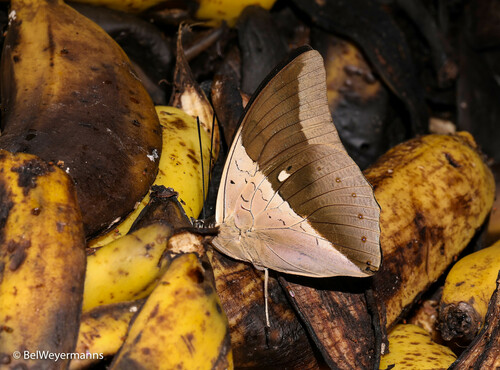
About Ariadne ariadne (Linnaeus, 1763)
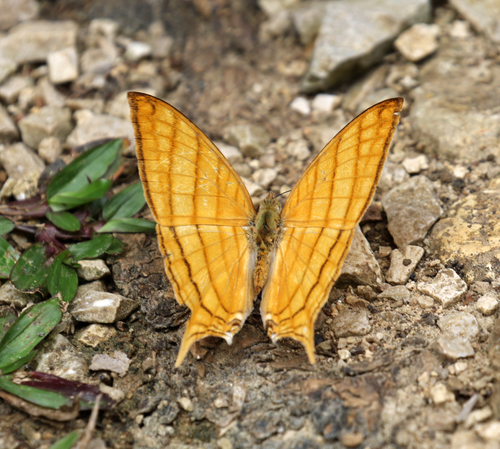
This species of butterfly, Ariadne ariadne, has an orange-brown base color marked with wavy lines that run across its wings. The outer margin of the forewing is somewhat wavy, and appears truncated at the wing apex. This margin has a large angle in the fifth vein interspace, as well as at the tip of vein three, and the tornus is broadly angled. The outer edge (termen) of the hindwing is deeply scalloped. A prominent white spot sits near the apex of the forewing. The wing cilia are white, alternating with brown. The underside of the wings shows more brown than the upper side. The antennae, head, thorax, and abdomen are ochraceous rufous in color. Males have a series of dark, shining scales called androconia on the subcostal vein, veins 6 and 7, and also have an androconial patch on the underside of the forewing near the base. Females are similar in appearance to males, but are slightly paler and have no androconial scales. Ariadne ariadne, commonly called the angled castor, closely resembles Ariadne merione, the common castor. Compared to the common castor, the angled castor has narrower, less diffuse transverse chestnut bands, and its wing margins are more wavy than those of the common castor. The most common larval host plant for this butterfly is the castor plant Ricinus communis, which gives the butterfly its common name. Other recorded host plants are Tragia cannabina, Tragia hispida, Tragia plukenetii, and Tragia involucrata.