About Arhopalus ferus (Mulsant, 1839)
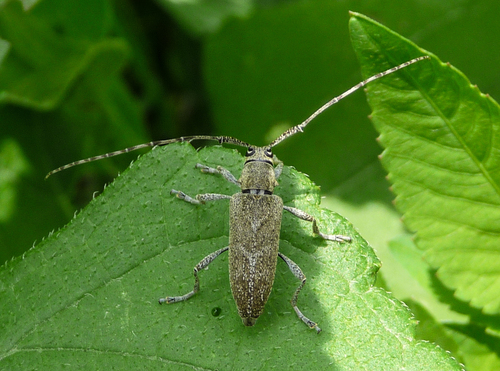
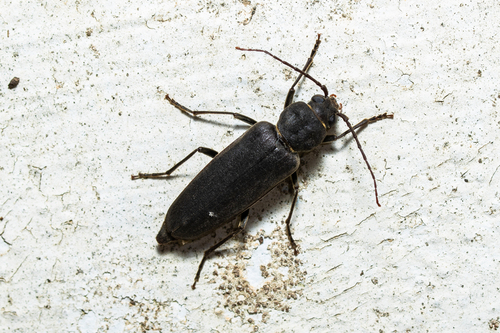
Arhopalus ferus (Mulsant, 1839) is a species of longhorn beetle. Adult beetles of this species measure 8–30 mm in length, and range in color from reddish-brown to black. Males are generally smaller and lighter in color than females. Their bodies are elongated and oval, which is characteristic of longhorn beetles. The head angles forward, exposing most of the mouthparts. The thread-like antennae reach half to three-quarters of the total body length, and are longer in males than in females. The prothorax has smoothly curved edges with no spines, and is narrower than the elytra. The elytra have four distinct ridges and slightly tapering sides. Eggs of Arhopalus ferus are white, opaque, and cigar-shaped, measuring approximately 0.5 by 1.8 mm. Larvae are creamy white, cylindrical, with visible legs and pointed jaws. They remain active when removed from their feeding tunnels. Arhopalus ferus naturally occurs across Europe, northern Asia excluding Japan, and North Africa. It was introduced to New Zealand, likely arriving in the 1950s, and was first reported in Australasia in 1970. Adult Arhopalus ferus live for several weeks, and emerge between spring and autumn. Females can lay up to around 1000 eggs, and prefer to deposit eggs in fire-scorched host material. Eggs are laid in groups of 5 to 50 within bark cracks, as early as 24 hours after a fire. Unburned host material can still support a smaller population of the species. Larvae hatch after approximately 10 days, and bore into the inner layers of host material, showing a preference for phloem and cambium, though they sometimes feed on sapwood. The larval tunnels are oval in cross-section, and can reach up to 12 mm wide. In the species' native range, Arhopalus ferus requires 3 to 4 years to complete its full life cycle. In introduced New Zealand populations, the species typically completes its life cycle in 1 to 2 years.