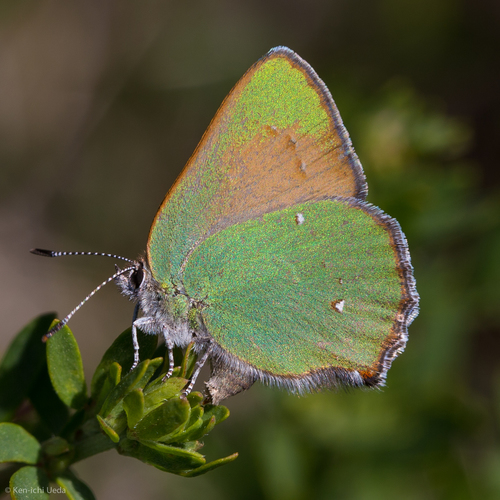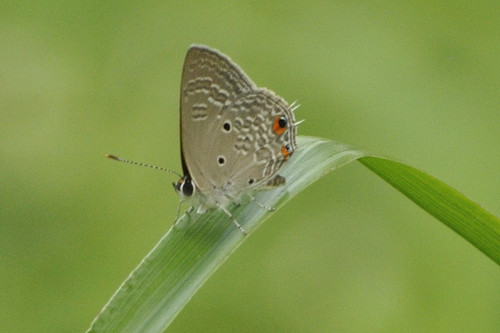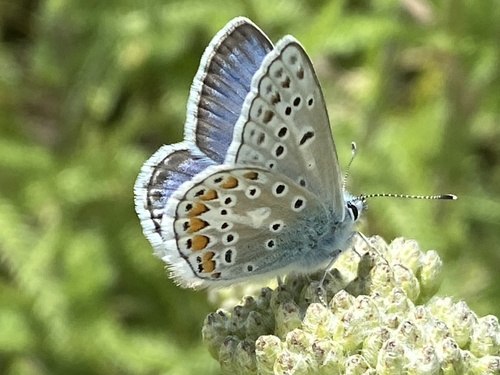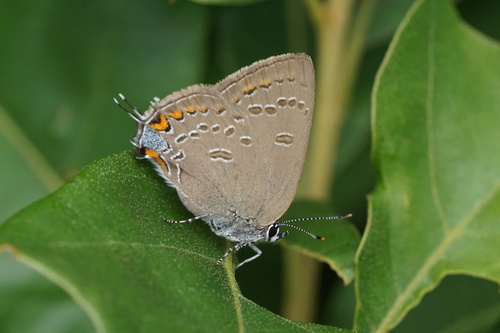
About Arhopala japonica (Murray, 1875)
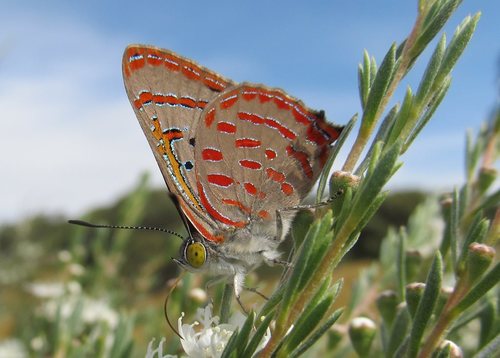
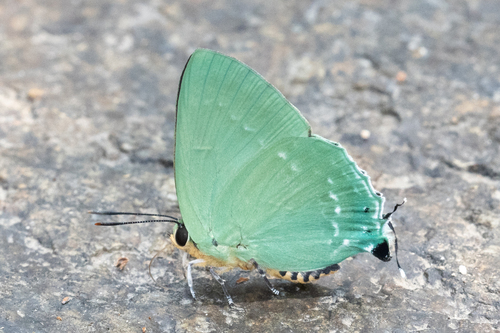
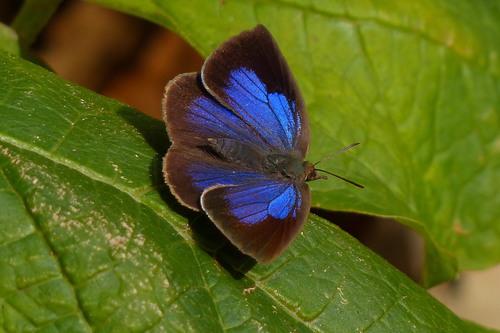
Arhopala japonica belongs to the Arhopala rama species group. According to Seitz’s summary, A. japonica is almost identical in appearance to A. rama, but lacks the tail appendage that A. rama has. Another similar species in this group, A. dodonea, has a pale earth-brown underside and light, dark-edged spotted bands. A. japonica occurs in Southern Japan, filling the range of A. rama in this region, while A. dodonea occupies the Palearctic portion of Kashmir. Both species are also found in some districts of India. A. japonica is additionally present in Formosa, where typical A. japonica is not at all rare according to Matsumura, alongside a distinct aberration: ab. horishana Mats. This aberration, described from a single female specimen, has broader dark margins on the upper wing surface, a distinctly darker underside, very narrow transverse bands, and much larger basal spots on the hindwing than standard A. japonica. A. dodonea, which de Niceville classifies as a dimorphic form of A. rama that flies alongside A. rama in some Kashmir valleys, also has a recorded aberration: ab. comica Nic., which is now recognized as the separate species Arhopala comica. This aberration originates from Bhamo in Upper Burma; its upper surface matches that of A. dodonea, while its underside has denser, more intense coloring and slightly spaced-out spotted markings. The adult butterflies of this group of forms are common in some regions. They are the only Amblypodia butterflies observed to fly among cornfields. They are likely the most cold-tolerant species in their genus. This species was found in dozens of individuals in Nagasaki on cool fresh autumn mornings. These butterflies range farther north than related species, and also extend higher vertically to cold, snow-prone altitudes. Doherty observed A. rama still flying in great numbers during winter near Ramgarh, at a time when the ground was covered in snow. The wingspan of Arhopala japonica measures 24–30 mm. The larvae of this species feed on Pasania edulis, Pasania glabra, Quercus acuta, Quercus glauca, Quercus serrata, Quercus stenophylla, Cyclobalanopsis glauca, Cyclobalanopsis gilva and Cyclobalanopsis acuta.