About Arhopala amantes (Hewitson, 1862)
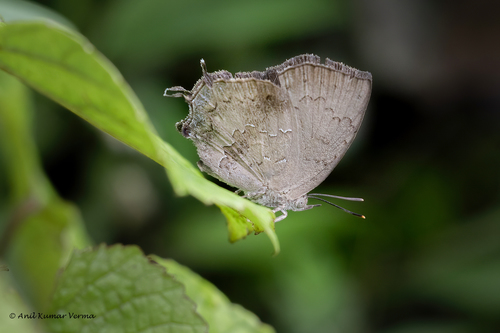
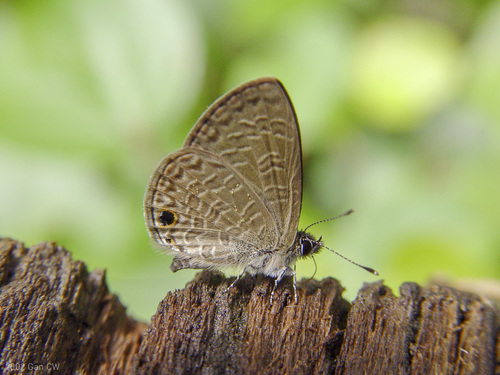
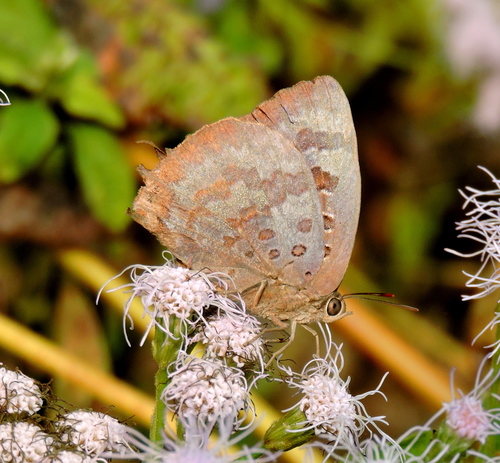
Male description: Upperside is dark purple-blue, which shines in certain lighting. Its colour is similar to that of Arhopala centaurus pirithous, but it is a brighter blue, with black costal and outer marginal lines. Cilia and tails are black; a rather long tail sits at the end of vein 2, and slight projections occur at the ends of all other veins of the hindwing. These projections are more pronounced at the ends of veins 1 and 3 than at the other veins. Underside is grey suffused with pinkish-brown; the lower portion of the forewing is pale, and the hindwing is darker than the forewing, though the overall shade of colour varies considerably. Spots and bands are chocolate-brown. The forewing has a small spot in the cell near the base, a larger spot in the middle of the cell, and four conjoined spots at the end of the cell. The third spot from the upper end is minute and sometimes absent. There is a discal band of conjoined spots extending from the costa to vein 2, with spots increasing in size towards the hindwings; the band is slightly outwardly curved, and sometimes nearly straight, but the middle spot is always positioned a little outside the others. All these spots and bands are edged with bluish-white. The forewing also has an indistinct brown sub-terminal band, and an even more indistinct terminal band. The hindwing has four sub-basal spots, with three arranged in a row, and the fourth located near the abdominal margin. These are followed by two spots, and an outwardly curved bar at the end of the cell with dark brown edges; two spots sit below this bar in an inward curve. There is an outwardly curved, irregular discal band of spots and curves, which starts on the costa with a large brown patch formed by two joined squarish spots. A thick, lunular brown sub-marginal line and a thinner anteciliary line are both more or less lunular. The anteciliary line is edged outwardly with bluish-white near the anal angle; a black spot in the lobe here is capped with bluish-white. There are faint indications of very similar, indistinct bands between the existing bands, and a black terminal line is present. Antennae are black; palpi are black above and whitish beneath. The head and body are blackish-brown above and grey beneath. Female description: Upperside is paler and brighter blue, which merges into black on the outer portions. This forms broad costal and outer marginal bands on the forewing, and a black spot is generally present at the upper end of the cell. The hindwing also has similar costal and marginal bands. These bands narrow significantly in the middle of the outer margin, then broaden towards the hind end, with some blackish suffusion extending upward near the pale abdominal space. The underside matches that of the male. Ecology: This is a butterfly that occupies the canopy of small trees, and occasionally comes down to settle on shrubs and low bushes. It flies frequently throughout the day, but typically has long resting periods between flights. When resting, it usually chooses a leaf exposed to full sun at a considerable height above ground. Eggs are laid on the leaves of Syzygium, Terminalia and Hopea species. Larvae and pupae are always attended by red ants. This species is not endangered.