About Arhopala abseus (Hewitson, 1862)
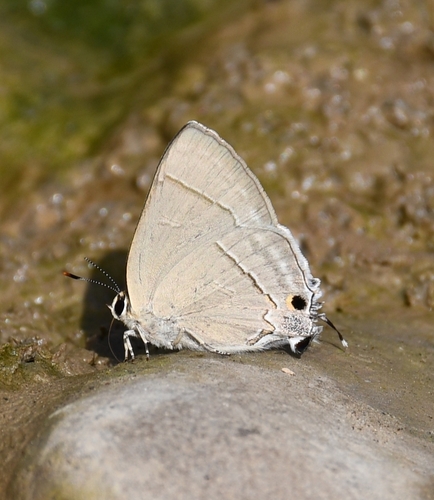
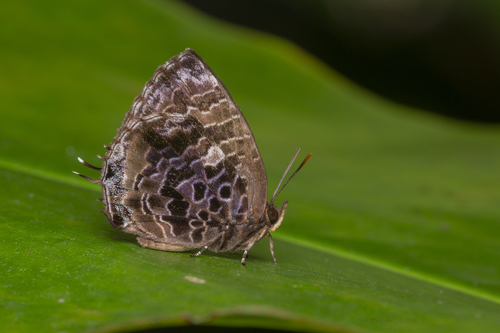
Description of male Arhopala abseus: Upperside is dark bright blue, with veins that are more or less black. The forewing has broad black borders, which gradually widen from the base of the costa to the apex of the wing, curving down the outer margin and broadening slightly at the hinder angle. The hindwing has a broad, fairly uniform black band along its costal and outer margins, with black extending broadly up the abdominal margin. At the end of vein 2, there is a rather long filamentous tail that is black with a white tip, and short black projections at the ends of veins 1 and 3. The costa is highly arched at the base, then nearly straight to the sub-acute apex. The outer margin is evenly rounded, except for the projections noted above. Cilia are black, with white tips toward the apices of both wings. On the underside: The forewing has a shining pinkish-grey ground colour, with the basal and upper half of the wing suffused with dark pinkish-brown, which fades slightly outward. Markings are darker brown, edged with whitish. Two round spots of nearly equal size sit inside the cell, with two paler spots below them. A band of conjoined square spots runs from the costa, increasing in size toward the hind end, crossing the end of the cell to vein 2; this band has two or three small projections on each side. A similar discal band of five conjoined spots runs from the costa to vein 3, with the fourth spot being the largest, its outer end projecting slightly outward. The band continues via two paler, narrower brown marks in the next two interspaces. There is a blackish terminal line, and a sub-terminal series of blackish lunules, with the three middle lunules being the most prominent. Between the terminal line and the sub-terminal series sits a darker line of conjoined lunular marks. The hindwing is nearly entirely suffused with dark pinkish-brown. It has a whitish mark on the middle of the costa, a sub-basal row of five conjoined spots (the four lower spots are round), followed closely by a row of four round spots, the last of which touches the fourth spot of the first row. There is an irregular, outwardly curved discal band, which is dislocated toward the hind end and obscured upward by the middle costa whitish mark, followed by an irregular narrow extra discal band. It has a blackish terminal line, and a sub-terminal series of indistinct pale brown lunular marks. There is a large narrow sub-terminal black spot in interspace 3, and a round black spot at the anal angle; both spots are capped with metallic blue-green scales. Antennae are black; palpi are black above and grey beneath; head and body are blackish above with dark blue pubescence, the thorax is brown beneath, and the abdomen is grey.