About Argyrodes miniaceus (Doleschall, 1857)
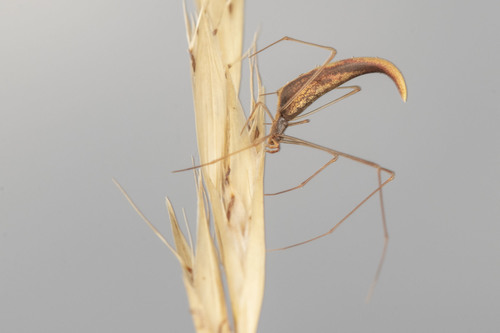
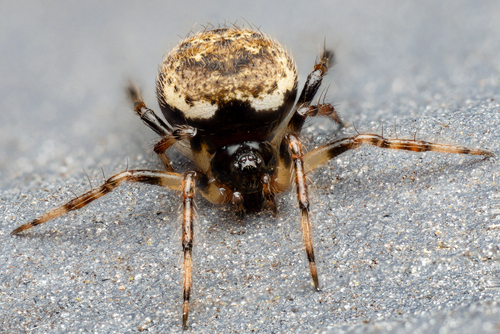
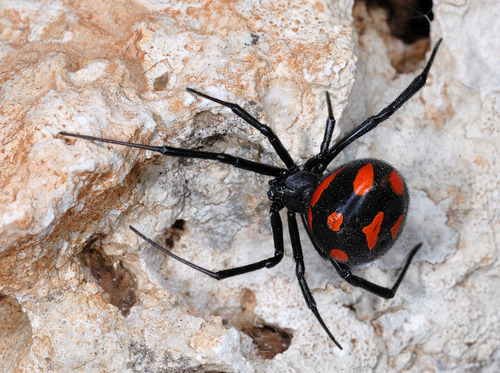
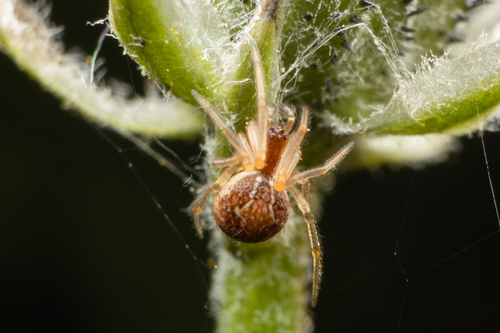
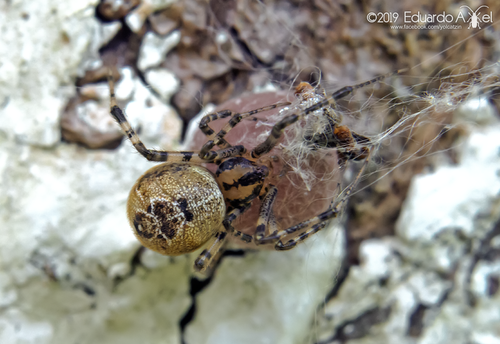
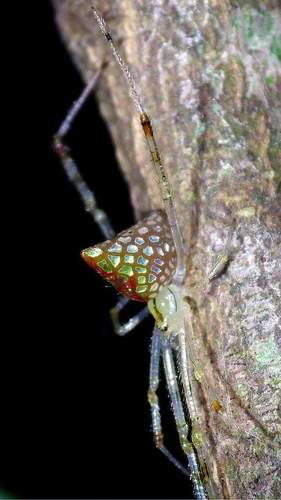
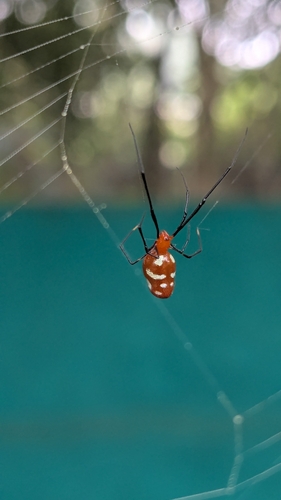
Argyrodes miniaceus is a small spider, with males reaching a body length of 3–4 mm and females reaching 3–5.3 mm. Its cephalothorax color ranges from testaceous to brownish-rufescent. The legs are mostly black with rufescent bases; the first and fourth leg pairs are yellow-testaceous, and their femora sometimes bear rufescent rings. When viewed from the side, the abdomen has a sub-triangular shape, positioned high and erect towards the posterior. Abdominal color ranges from gray to brownish-testaceous, and may sometimes appear blackish. It has characteristic markings: a small black spot at the posterior tip of the dorsum, and black spots above the anus. Typically, the abdomen also has paired white spots or stripes on each side, located in higher, more posterior positions. Males have distinct modifications to the head: the head is transversely cleft in front of the lateral eyes, forming lobes that create an oval opening between them, with black hair above the opening. The upper lobe is sub-conical, curves downward, and holds the median eyes. The lower lobe is either sub-conical or triangular, has an obtuse apex, and curves slightly upward. Argyrodes miniaceus has a wide distribution across the Asia-Pacific region, spanning from India, Korea, and Japan to Australia. It has been recorded in many countries, including China, where it was originally misidentified as the separate species Argyrodes miltosus. Argyrodes miniaceus is a kleptoparasitic species: instead of building its own prey-capture webs, it steals prey from the webs of other spiders. This kleptoparasitic behavioral strategy is typical of many species in the Argyrodes genus.