About Argyrochosma nivea (Poir.) Windham
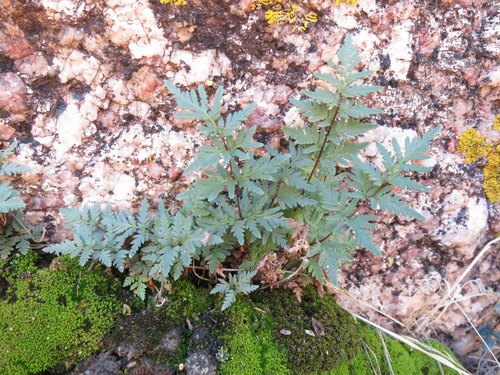
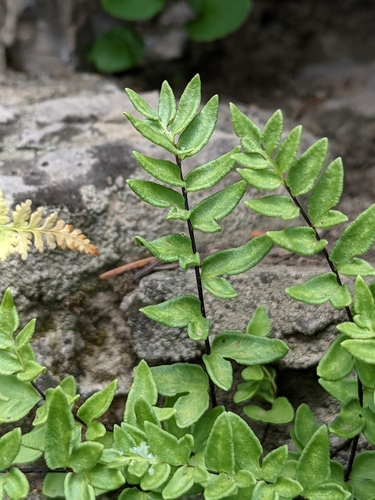
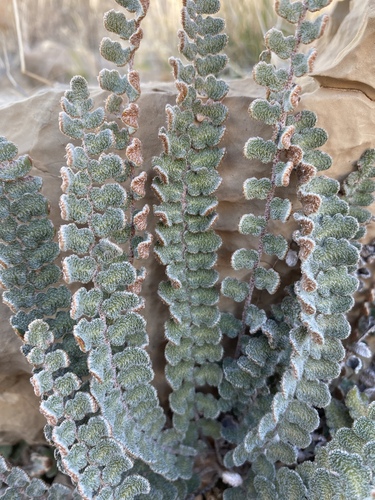
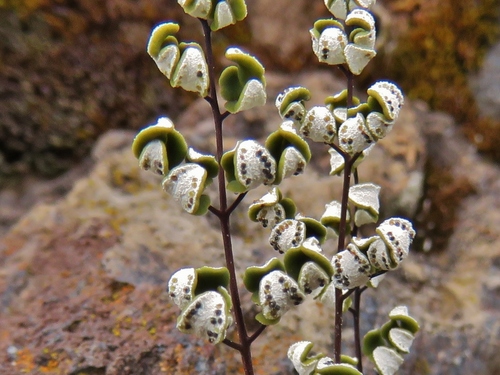
Argyrochosma nivea (Poir.) Windham has a short, thick, more or less upright rhizome. The rhizome bears thin, delicate linear-subulate scales, 2.5 to 3 millimeters (0.098 to 0.12 in) long, uniformly colored chestnut-brown. The scale margins are entire, meaning they lack teeth, or the walls of the marginal cells may project from the margin. The scales often become strongly crisped, or wavy, when dried. Leaves are 10 to 30 centimeters (3.9 to 12 in) long and grow close together from the rhizome. The stipe, the stalk of the leaf below the blade, is slender, rounded, and dull rather than shiny. It lacks both hairs and scales, and its color ranges from bright to dark chestnut-brown. It is typically shorter than the leaf blade, or about as long as the leaf blade. Leaf blades are lanceolate, deltate-lanceolate, or ovate in shape, and are tripinnate, meaning they are cut into pinnae, pinnules, and pinnulets. The rachis, the central leaf axis, has a similar appearance to the stipe. Blades bear up to 12 pairs of nearly opposite pinnae, each attached to the rachis on a stalk. Pinnae are ovate to lanceolate in shape. Pinnules are long and also borne on stalks. Pinnulets are broadly oblong to nearly orbicular (circular), with blunt (obtuse) tips and bases that are abruptly cut off (truncate) to nearly heart-shaped (cordate). Pinnulet margins are entire. The dark color of the segment stalks ends abruptly at a joint at the base of the leaf segment. The segment at the tip of the pinnule is often lobed. Leaf tissue has a leathery texture, with no hairs or scales on the upper surface, and is densely covered in white powdery farina on the lower surface. On fertile leaf segments, sporangia lie close to the margin, borne along the distal quarter to half of the secondary veins branching from the segment midrib. Each sporangium holds 32 spores. The leaf margin tissue has the same texture as the rest of the leaf, and is not modified into a false indusium. This species occurs from Ecuador south to Argentina along the Andes. It typically grows in rock crevices or on rocky soil in dry valleys, often in open areas within deciduous forest. It is found at altitudes ranging from 1,650 to 4,500 meters (5,410 to 14,800 ft).