About Argyrochosma jonesii (Maxon) Windham
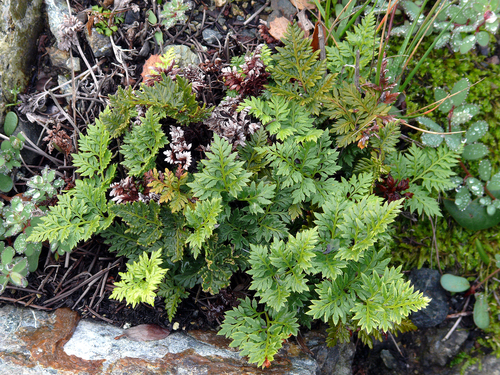
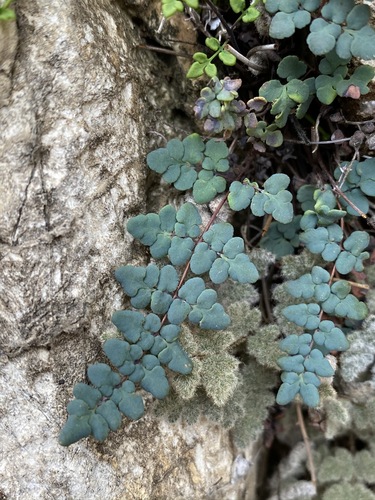
Argyrochosma jonesii (Maxon) Windham has a short, horizontal rhizome with closely spaced leaves. The rhizome bears linear or linear-subulate, uniformly colored brown or reddish-brown scales that are sometimes nearly black. These scales have entire (toothless) margins, a thin texture, a length of 5 to 7 millimeters (0.2 to 0.3 in), and a width of 0.3 millimeters (0.01 in). Leaves are 4 to 15 centimeters (1.6 to 5.9 in) long, grow in clumps, and emerge from the rhizome. The stipe, the leaf stalk below the blade, is chestnut brown, reddish-brown, or dark brown. It is rounded, hairless, 0.75 to 1.5 millimeters (0.030 to 0.059 in) in diameter, and typically 2 to 6 centimeters (0.79 to 2.4 in) long, making up roughly one-half to two-thirds of the leaf's total length. The leaf blade is ovate to lanceolate, ranging from bipinnate (divided into pinnae and pinnules) to tripinnate (with pinnules further divided into pinnulets) at its most divided base, and does not narrow at the base. The blade measures 3 to 7 centimeters (1 to 3 in) long and 0.8 to 3 centimeters (0.3 to 1 in) wide, with a blunt (obtuse) base and a pointed (acute) tip. The rachis, the central leaf axis, is rounded or slightly flattened on its upper side, and sometimes shallowly grooved. It and the axes of the leaf segments are dark in color, with this dark color extending into the base of the leaf segments without forming a distinct joint. The axes are straight, not zig-zagging. Each blade has 4 to 6 pairs of ovate or deltoid-ovate pinnae. These are further divided into 2 to 3 pairs of circular (orbicular), deltoid, or ovate pinnules. Pinnules are obtuse at the tip, heart-shaped (cordate) or abruptly terminating (truncate) at the base, and borne on a short stalk. Pinnules closest to the blade base may be subdivided into an additional set of segments, while pinnules closer to the blade tip are lobed or entire. Leaf tissue is dark blue-green with a leathery to fleshy texture that obscures veins from the upper surface. It has no hairs or scales on either surface, and unlike many species in the genus Argyrochosma, it does not have farina (powder) on either leaf surface. Leaves do not curl when they dry. On fertile leaf segments, sporangia sit close to the margin, borne along the distal half of secondary veins that branch from the segment midrib. Each sporangium holds 64 spores. Leaf segments are at most slightly curled under, which does not conceal the sporangia, and their tissue is not modified into a false indusium. A. jonesii is a sexual diploid with a chromosome count of 2n = 54. While a tetraploid cytotype was once thought to exist, this is now believed to form when plants occasionally produce 32 diploid spores, rather than 64 haploid spores, which then grow into diploid gametophytes. It is most similar in appearance to its close relative Argyrochosma lumholtzii, and both species are found in Sonora. A. lumholtzii differs by having a darker leaf stalk and axes, and less highly divided leaves. In terms of distribution and habitat, Argyrochosma jonesii is found in the United States in California, Arizona, Nevada, and southern Utah, and in Mexico in Sonora. It occurs particularly within the Mojave and Sonoran Deserts, where it grows on calcareous or igneous cliffs and ledges at altitudes between 600 and 1,900 meters (2,000 to 6,200 ft). In cultivation, it prefers high light, moist-dry to dry well-drained soil that may have a high pH.