About Argyranthemum frutescens (L.) Sch.Bip.
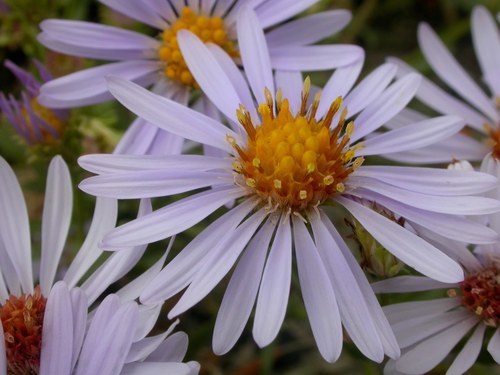
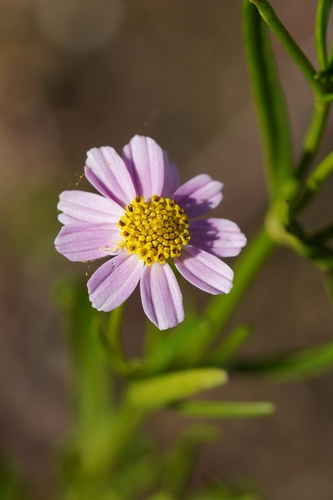
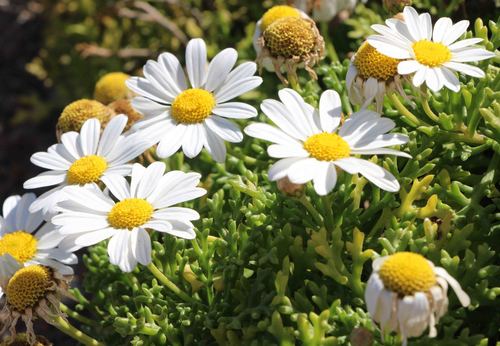
Argyranthemum frutescens (L.) Sch.Bip. is a perennial shrub that reaches 20–80 cm (7.9–31.5 in) in height. It is heavily branched, typically forming a rounded, bushy shape with ascending to upright stems. Its leaves are arranged alternately, are somewhat fleshy, and are blue-green to green in color. Leaf shapes range from oval to oval-lanceolate, measuring 1–8 cm (0.4–3.1 in) long and 4–6 cm (1.6–2.4 in) wide. The species produces loose inflorescences holding 4 to 30 daisy-like flower heads. Each flower head is white with a yellow center, and can grow up to 2 cm (0.79 in) in diameter. In most subspecies, the ligules of the outer ray florets are around 8 mm long, pure white, and female. These ray florets produce fertile achenes that are triangular to horn-like winged. Achenes from the yellow tubular central florets are sterile and have one wing. The pappus is always shaped like an irregular crown. The flowers are strongly fragrant, and open their petals in the morning before closing them at night. Like all other Argyranthemum species, this plant, also called shrub marguerite, is native to the Canary Islands. It is common in coastal regions of El Hierro, La Gomera, Tenerife and Gran Canaria, but is very rare on La Palma. It is the most common species of the Argyranthemum genus across the Canary Islands. It typically grows in succulent shrubland habitats, in well-drained, poor soils located in full sun, most often near the coast at elevations up to 700 meters. For healthy growth, this species requires full sun, large amounts of organic matter, and very well-drained soil. Overwatering can kill the plant. It tolerates cool low temperatures, but cannot survive freezing conditions. It also requires full sunlight exposure and must be protected from wind. Argyranthemum frutescens subsp. canariae has been awarded the Royal Horticultural Society's Award of Garden Merit (AGM). Many plants cultivated under the name "Argyranthemum frutescens" are garden marguerite cultivars, and some are hybrids between this species and other related genera. Cultivars produce abundant daisy-like flowers, which can be single or double, and come in shades of white, pink, yellow and purple. They bloom throughout the summer. In the climate of the United Kingdom, these cultivars are generally half-hardy. They can be grown from seed or cuttings, or purchased as young plants to plant out after all risk of frost has passed.