About Argynnis hyperbius (Linnaeus, 1763)
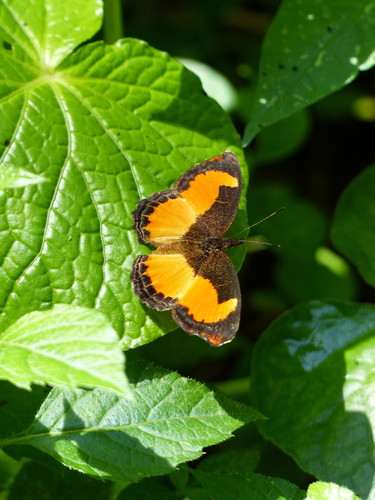
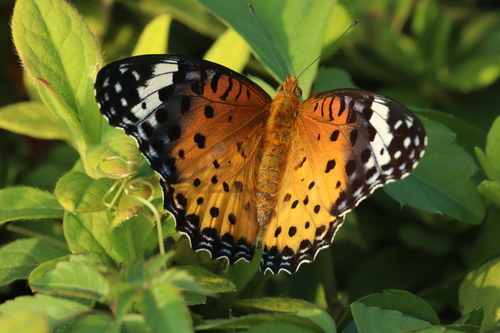
This species, Argynnis hyperbius (Linnaeus, 1763), has the following detailed morphological description. Males have distinct wing markings: on the upperside, the forewing is rich orange yellow and the hindwing is paler yellow, both marked with black patterns. On the male forewing, the cell contains a short basal transverse streak and a medial broad oval loop with a sinuous outer margin; there is also a broad transverse streak beyond the cell that does not reach the median nervure, a broad streak along the discocellulars, a zigzag discal series of large spots (angled outward in interspace 4 and inward in interspace 2), plus a minute spot at the base of interspace 1. There is a somewhat diffuse large postdiscal spot below the costa in interspace 6, a postdiscal sinuous series of round spots (very small in interspaces 1 and 4), an inner complete subterminal sinuous series of round spots, an outer subterminal line that widens across the veins, and a slender terminal line. On the male hindwing, there is a basal, transverse, obscure narrow mark in the cell, another above it in interspace 7, and a transverse lunule across the middle of the cell; a small spot borders the lower discocellular on its outer edge. A discal series of transverse spots runs from interspaces 1 to 7, curving sinuously posteriorly, followed by a postdiscal series of five spots in interspaces 2 to 6, a subterminal series of somewhat lunular spots, and finally a narrow termen band, traversed posteriorly by a series of blue lunules and anteriorly by a series of ochraceous lunules. On the underside, the male forewing is pale terracotta red, shading to ochraceous towards and broadly suffusing the apex; markings match the upperside, with the following exceptions: the subcostal spot in interspace 6, the upper two spots of the postdiscal series, the upper four spots of the inner subterminal series, and the anterior portions of the outer subterminal and terminal line are olivaceous brown; the upper two postdiscal spots have white centers, with one white spot on each side; the upper four spots of the subterminal series are united (connate) to form a short curved band. The male hindwing is variegated with ochraceous, olivaceous-brown and silvery-white markings; silvery-white markings are mostly narrowly margined on the outer side by short black lines, and the veins are prominently pale ochraceous. The medial silvery markings form a distinct sinuous discal series, followed by a curved postdiscal series of five olivaceous round spots; every spot and the olivaceous-brown quadrate patch near the base of the cell has a minute white central spot. A slender black subterminal line widens at the veins (as it does on the forewing), followed by an ochraceous narrow lunular band and an outer slender black anteciliary line; the inner side of the subterminal black line is bordered by a series of slender white lunules, which are inwardly bordered by a series of broad olivaceous-brown markings in the interspaces. Male antennae are brown above and ochraceous red beneath; head, thorax, and abdomen are olivescent tawny, while the palpi, thorax, and abdomen are pale ochraceous on the underside. Females are generally similar to males, but differ in the following features. On the upperside, the apical half of the forewing, extending from about the middle of the costa obliquely to just above the tornus, is black, inwardly suffused with purple, and crossed by a broad white band that runs from the costa to the subterminal series of black spots; there are four preapical white spots, with the upper three bordering each side and above a very obscure, barely visible ocellus on the black background, and there are inner and outer subterminal transverse series of slender white lunules. On the underside, forewing markings match the upperside, but the apex of the wing beyond the white oblique band is ochraceous green. The hindwing matches that of the male, but its markings are slightly broader. Antennae, head, thorax, and abdomen match the male, but the female abdomen is paler on the underside. The species' total wingspan ranges from 80–98 mm (3.1–3.9 in). Several geographic variants and races are recognized. Variety taprobana, Moore, is a slightly darker race native to Ceylon, with markings in both sexes that match those of typical A. hyperbius. Moore notes that taprobana is an intermediate between the south Indian race castetsi and typical Ceylon A. hyperbius specimens, which only differ from specimens from upper India, Assam, and Burmese by having very slightly darker upperside ground color. For race castetsi, Oberthur, females of this form appear to be locally dimorphic. Males closely resemble typical A. hyperbius males, but differ as follows: the upperside ground color is a richer, brighter shade of orange yellow; black markings match in pattern but are distinctly smaller and a deeper black; the subterminal transverse series of slender lunules crossing the terminal black margin on the hindwing matches the orange yellow ground color, and is not blue on the posterior half of the wing. On the underside, the olivaceous brown at the forewing apex and the variegation on the hindwing carry more of a greenish golden tint, and a sex-mark of specialized raised scales along the middle of vein 1 on the forewing upperside is very prominent. The Nilgiri form of castetsi female resembles typical A. hyperbius females, with the following differences: the upperside ground color is pale golden yellow; the basal half of both forewings and hindwings is shaded with metallic green on the forewing (this tint is slightly olivaceous in some specimens); black markings and the white oblique band on the forewing's apical area match those of typical A. hyperbius, but are proportionately smaller; the purplish-blue shading along the inner margin of the white band, and the bluish tint on the forewing's white preapical spots and subterminal markings, and on the posterior half of the hindwing's subterminal line of lunules, are much less conspicuous. On the underside, markings match typical A. hyperbius but the forewing ground color is a paler shade of terracotta red, and the olivaceous brown variegating the hindwing is a distinctly greener tint. The typical form of castetsi female, described from Trichinopoly, is similar to the castetsi male and differs as follows: the upperside ground color is pale golden yellow; the basal half of the wings is suffused with dark olivaceous green; black markings match the male but are larger; on the forewing, the spots of the subterminal series are very large, coalescent or nearly coalescent with each other and with the dentate spots on the veins of the inner terminal line; the upper two spots of the postdiscal series are also very large and coalescent, with the upper spot joining above and below to the inner postdiscal lunate spot in interspace 6, enclosing a prominent lunule of the ground color. On the underside, markings match the male but are paler. This species has a documented distribution: it occurs in the outer ranges of the Himalayas from Campbellpur in the Punjab to Sikkim, as well as Oudh, Agra, Manbhum in Bengal, Assam, the Khasi Hills, Upper Burma, and extends into China, Taiwan, Sumatra, Java, and southern Japan. In Australia, its range is restricted to northern New South Wales and southern Queensland. The species was first observed in the United Arab Emirates in January 2020 in Wadi Wurayah National Park, in the Hajar Mountains within the Emirate of Fujairah, where a few Indian fritillaries were found flying alongside individuals of the physically similar species the Plain tiger (Danaus chrysippus). It is thought that these individuals arrived as opportunistic migrants, attracted by suitable conditions created by abundant rainfall in the country since October 2019, and that they will not remain through the summer.