About Argiope submaronica Strand, 1916
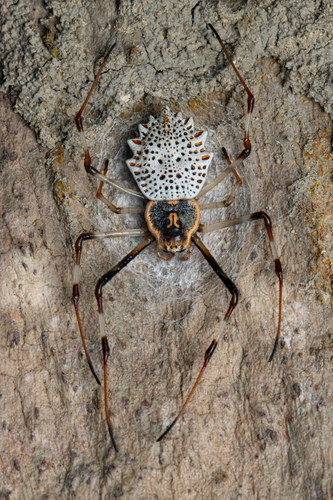
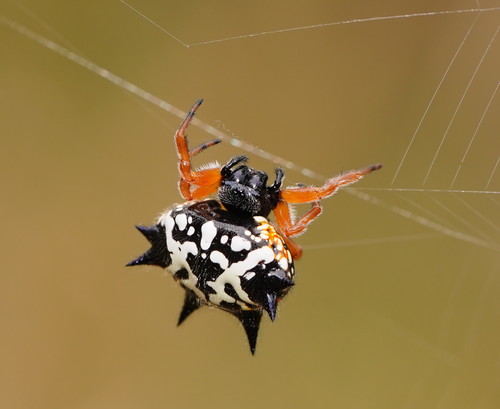
Argiope submaronica Strand, 1916 is a species of orb-weaver spider in the family Araneidae. Its distribution ranges from Mexico to Bolivia, and it is also found in Brazil. At one point, this species was considered a synonym of Argiope argentata, but it is currently recognized as a separate valid species. It has also been known under the taxonomic synonym Argiope savignyi.
In Costa Rica, Argiope submaronica was observed capturing and feeding on the proboscis bat Rhynchonycteris naso. The spider fully encased the captured bat in silk over the course of a day. An observational study conducted at La Selva Biological Station confirmed that bats become caught in the spider’s web, before being fully wrapped in the spider’s silk. The spider was observed staying near or on the captured bat over the course of the day, and the spider’s manipulation of its mouthparts on the bat indicated active feeding.
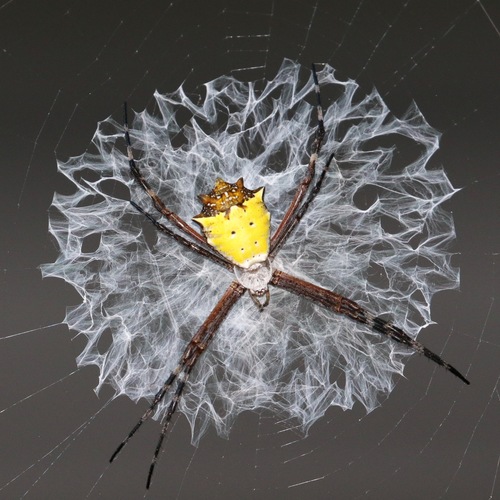
This observation was the first recorded instance of an emballonurid bat being preyed on by an invertebrate, as well as the first documented proof that spiders of the genus Argiope are capable of catching and consuming a mammal. When described under the synonym A. savignyi, this spider sometimes spins a silk disc web decoration, sometimes a cruciate pattern decoration, and sometimes produces a decoration that combines both types. These web structures are hypothesized to serve five potential functions: protection from predators, advertising presence to vertebrates to prevent accidental web damage, prey attraction, increased web stability, and provision of shade. Different decoration designs are associated with different purposes or functions.