About Argiope aurantia Lucas, 1833
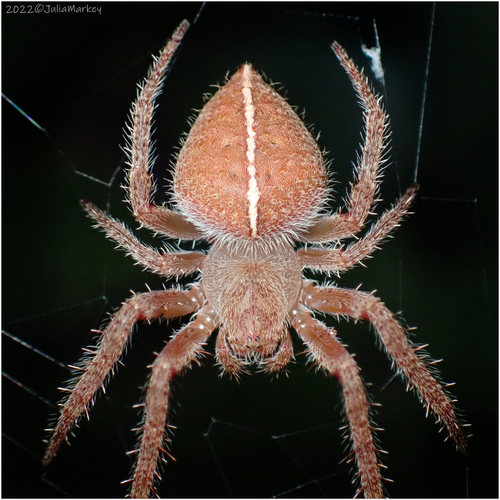
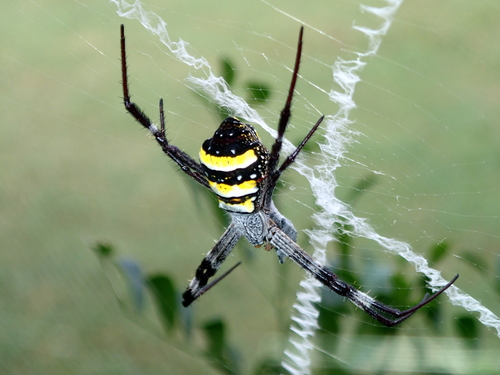
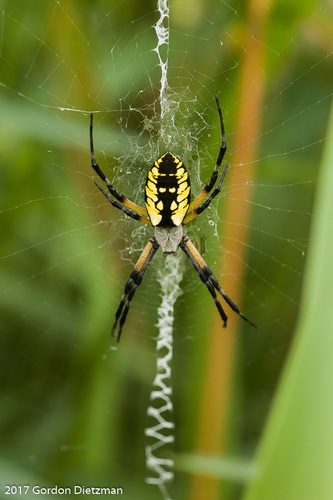
Argiope aurantia, first described by Hippolyte Lucas in 1833, is a species of spider with many common names: yellow garden spider, black and yellow garden spider, golden garden spider, writing spider, zigzag spider, zipper spider, black and yellow argiope, corn spider, Steeler spider, and McKinley spider. It is common in the contiguous United States, Hawaii, southern Canada, Mexico, and Central America, and ranges across the Americas from Canada to Colombia, occurring less frequently in the basin and mountain regions of the Rockies. This spider has distinct yellow and black markings on its abdomen, and a mostly white cephalothorax. Its scientific Latin name translates to "gilded silver-face": the genus name Argiope means "silver-face", while the specific epithet aurantia means "gilded". Male body length ranges from 5–9 mm (0.20–0.35 in), while female body length ranges from 19–28 mm (0.75–1.10 in); the average female body mass is approximately 752.0 mg. These spiders may bite if disturbed or harassed, but their venom is harmless to non-allergic humans, with an intensity roughly equivalent to a bumblebee sting.
Yellow garden spiders most often build webs near open sunny fields, where they stay hidden and protected from wind. They can also be found along the eaves of houses and outbuildings, or in any tall vegetation that allows them to securely stretch a web. Female Argiope aurantia tend to be relatively sedentary, often remaining in one place for most of their lifespan.
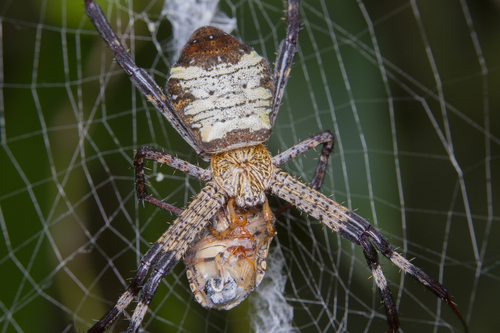
The web of the yellow garden spider is distinctive: it is circular, reaching up to 2 feet (60 cm) in diameter, and has a dense zigzag of silk called a stabilimentum at its center. The function of the stabilimentum is still debated. Proposed purposes include camouflaging the spider waiting at the center of the web, attracting insect prey, and warning birds of the hard-to-spot web. Only day-active spiders build stabilimenta in their webs. To construct the web, the spider stretches several radial lines between four or five anchor points that can be over three feet apart. All radial lines meet at a central point. The spider builds a frame with additional radial lines, then fills the central area with a spiral of silk, working outward clockwise starting from the innermost ring, and leaving a 7.9–9.5 mm (0.31–0.37 in) gap between consecutive spiral rings. To keep the web taut, the spider bends radial lines slightly inward as it lays the silk spiral. Females build far larger webs than males; males have small zigzag webs that are typically located near the female's web.
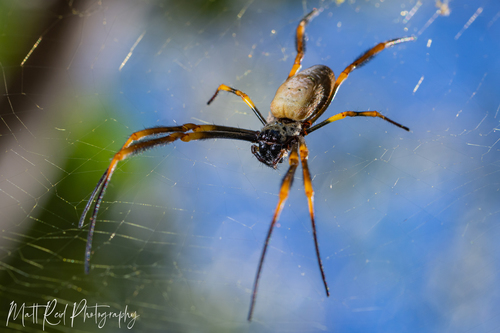
The spider waits for prey in the center of the web, usually facing straight downward. If disturbed by a potential predator, it may drop from the web to hide on the ground nearby. Webs normally stay in one place for the entire summer, but spiders may move to new locations early in the season, likely to find better protection or hunting conditions. Yellow garden spiders can vigorously shake their web while staying firmly attached to its center. This behavior may make it harder for predators like wasps and birds to target them, and also helps fully entangle insects before they can cut themselves free. One observed case in Georgia recorded a European hornet (Vespa crabro) flying into an Argiope aurantia web, becoming tangled, and cutting free prey already caught in the web; Argiope aurantia did not confront or fight the hornet, and instead dropped from the web to hide nearby. Unlike other orb spiders such as the golden orb web spider, yellow garden spiders do not form dense clustered groups. They also maintain clean, orderly webs, unlike the cluttered sequence of built and abandoned webs created by groups of golden orb spiders.
Yellow garden spiders breed twice a year. Males roam to find females, build a small web near or inside the female's web, then court females by plucking strands of her web. When a male approaches a female, he typically has a safety drop line prepared in case she attacks him. The male uses palpal bulbs on his pedipalps to transfer sperm to the female. After inserting the second palpal bulb, the male dies, and is sometimes eaten by the female.
The female lays her eggs at night onto a sheet of silky material, then covers the eggs with another layer of silk, followed by a protective brownish silk layer. She uses her legs to shape the sheet into a ball with an upturned neck. Egg sacs measure 5/8" to 1" in diameter. Females may suspend the egg sac near their web, or place it several feet away. Each spider produces between one and four egg sacs, which can each hold over a thousand eggs; on average, females produce clutches of around 978 eggs. Each egg is about 0.92 mm in diameter and weighs roughly 0.46 mg. In spring, young spiders exit the egg sac. Spiderlings are extremely small, and look like dust collected inside the silk mesh. Some spiderlings remain near the egg sac, while others release a strand of silk that catches the wind and carries them to more distant locations.