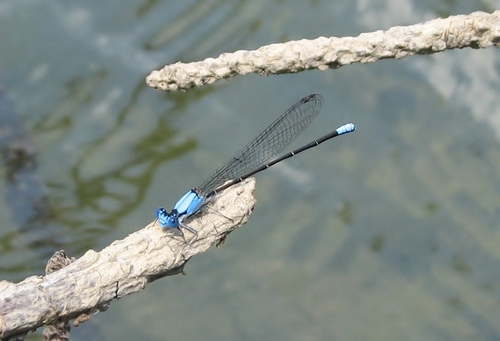
About Argia apicalis (Say, 1840)
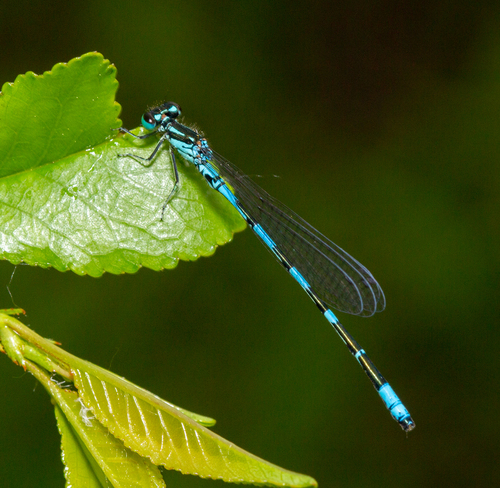
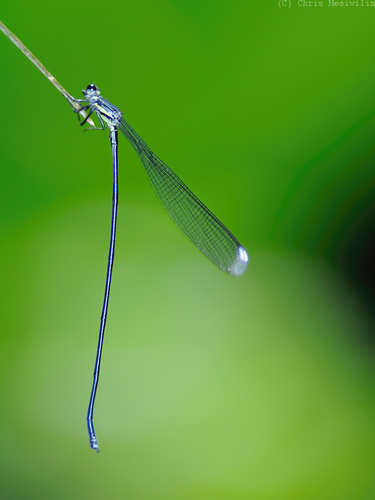
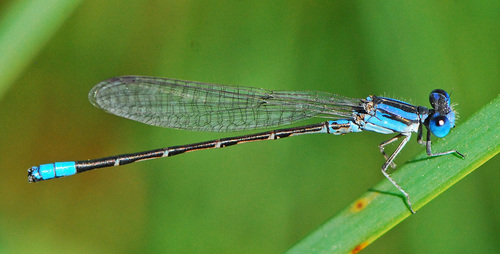
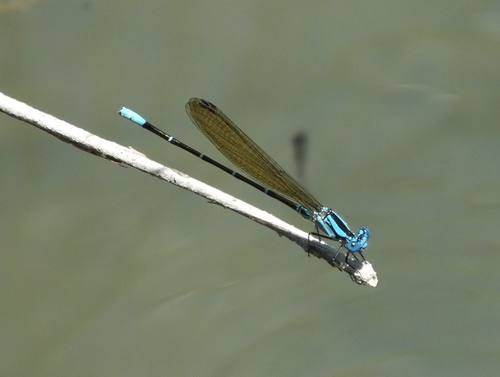
This species of damselfly, scientific name Argia apicalis (Say, 1840), has a total length between approximately 33 and 40 mm (1.3 and 1.6 in). Most males have a blue thorax, marked by a few black lines separating the thoracic plates. Males also have an abdomen with colored tips: abdominal segments eight, nine, and ten are bright blue, while all remaining abdominal segments are dark brown. The thoracic color of Argia apicalis is variable, and some males may be greyish-black instead of blue. Individual males can change back and forth between these two color phases over the course of several days, passing through multiple intermediate variations in the process. Neither of these male color phases appears to be specifically linked to age or sexual maturity. Females have three distinct thoracic color phases: brown, turquoise, and grayish-black. Like males, female color phase changes typically occur gradually, and none of the female color phases are associated with a specific age or maturity state. Argia apicalis has a broad distribution across North America. Its range extends from Ontario, Canada, across almost all of the United States (excluding the extreme southwest), and reaches south to the Mexican state of Nuevo León. This damselfly lives in a variety of habitats, including areas near large and small rivers, streams, lakes, and ponds. It is most commonly found near large, muddy rivers. While it is typically found in woodland, it can also occur in treeless landscapes.